You’ve typed it both ways and autocorrect hasn’t stopped you either time, so now you’re stuck wondering which one is actually right. Is your neighbor “nosy” or “nosey” when she watches the street from behind her curtains?
Here’s the short version: both spellings exist, both are pronounced the same, and dictionaries recognize both. But one of them is far more common, and knowing which one saves you a second guess every time you write it.
Quick Answer: Nosey or Nosy, Which One Wins
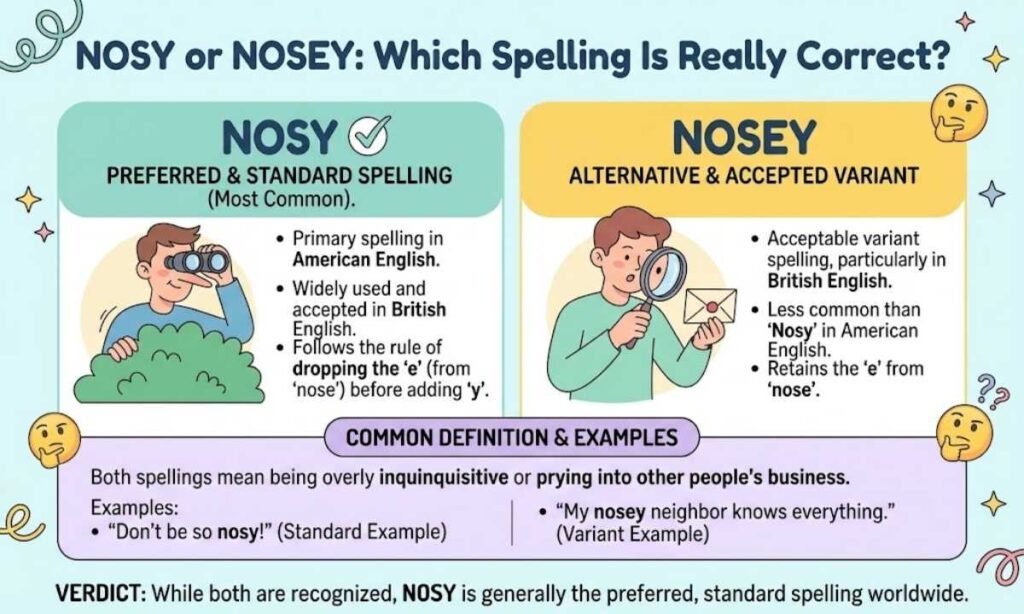
“Nosy” is the standard, most widely used spelling in both American and British English. “Nosey” is a recognized variant spelling, not a typo, and you’ll still see it in casual writing, older British text, and in the expression “nosey parker.” Dictionary sources describe nosey as a much less common spelling of nosy, so if you only remember one rule, remember this: default to “nosy,” and treat “nosey” as an accepted alternative rather than a mistake.
Does Nosy Actually Mean the Same Thing as Nosey
Yes, completely. Both spellings describe someone who is unduly curious about other people’s business, someone who pries, snoops, or asks questions that go past the line of polite interest. Neither spelling carries a different shade of meaning; the difference is purely orthographic.
• Both describe a person, a question, or a behavior
• Both can apply to a neighbor, coworker, relative, or stranger
• Both usually carry a mildly disapproving, sometimes playful, tone rather than a harshly negative one
Nosy vs Nosey at a Glance
| Feature | Nosy | Nosey |
| Meaning | Overly curious about others’ affairs | Identical meaning |
| Frequency | Far more common in print | Less common variant |
| American English | Preferred, standard form | Rarely used, seen as informal |
| British English | Also preferred | More accepted, especially in “nosey parker” |
| Formal writing | Recommended | Best avoided |
| Pronunciation | “NOH zee” | Same, “NOH zee” |
Where the Word Nosy Actually Comes From
The word traces back to the 1610s, when it originally described someone with a large or prominent nose, built from “nose” plus the suffix “-y.” The sense shifted to mean inquisitive only from 1882 onward, and the phrase referring to an inquisitive person as “Nosey Parker” appeared around 1890. So the curiosity meaning is actually the newer one; the word started out purely physical.
Why So Many People Spell It Nosey Instead?
The mix-up isn’t random. A few things push writers toward the extra “e”:
• It looks and sounds exactly like “nose” with a suffix tacked on, and being nosy often gets described as “sticking your nose in”
• English already has a long list of common words ending in -ey, such as money, honey, key, and valley, which trains the eye to expect that pattern
• The two spellings are pronounced identically, so your ear gives you no clue about which one is correct
None of that makes “nosey” wrong exactly, it just explains why the confusion persists generation after generation.
Nosy in American English vs British English
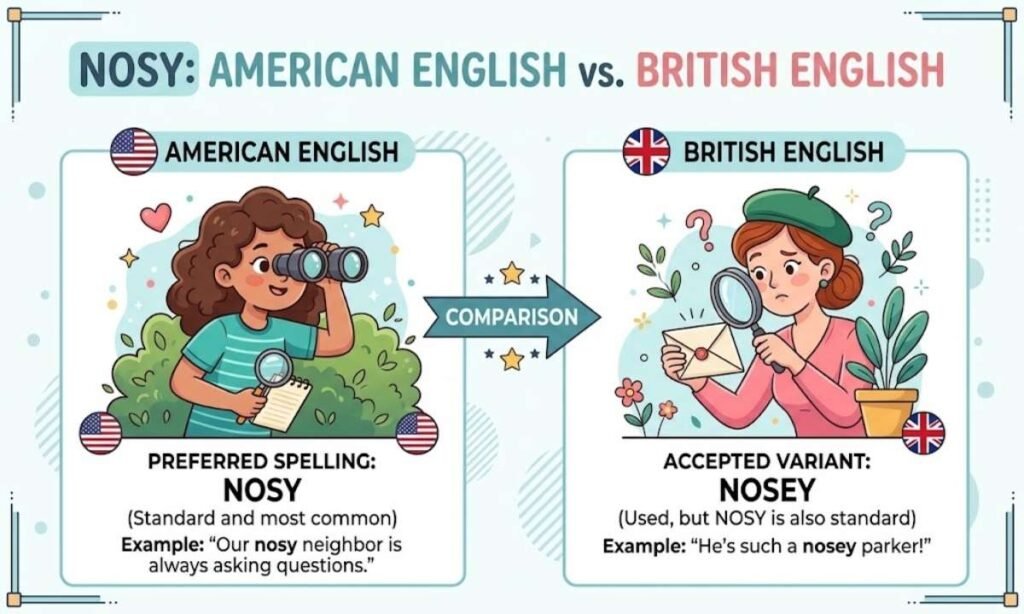
In the United States, “nosy” is the spelling you’ll find in news writing, style guides, and everyday use, and it’s the one spellcheckers default to. In the United Kingdom, “nosy” still leads, but “nosey” shows up noticeably more often, particularly inside set phrases.
If you’re writing for a US audience, stick to “nosy” without hesitation. If you’re writing for a UK audience or referencing British idiom, either spelling will read naturally, though “nosy” is still the safer, more modern default.
Nosy Neighbor or Nosey Neighbor
This is the single most searched version of the phrase, and both forms appear constantly in everyday speech, sitcoms, and local news stories. A nosy neighbor is someone who watches your comings and goings, asks questions about your personal life, or comments on things that aren’t really their business.
Example sentences:
• Our nosy neighbor already knew about the new baby before we announced it.
• She gave the nosey neighbor a polite but firm no when asked about the renovation cost.
Nosy Parker: The One Place Nosey Still Thrives
“Nosy parker,” sometimes written “nosey parker,” is a British informal term for someone who meddles in other people’s affairs. Merriam-Webster defines it as a chiefly British, informal, and disapproving term for a person who is too interested in what other people are doing. The phrase’s origin is genuinely uncertain; the popular story links it to Matthew Parker, a 16th century Archbishop of Canterbury known for prying into his clergy’s affairs, but the earliest print record of the phrase only dates to 1890, long after Parker’s lifetime, so most word historians treat that origin story as folklore rather than fact.
Nosy vs Noisy: Don’t Let Autocorrect Trick You
These two words are one letter apart and get mixed up constantly, especially on mobile keyboards. They mean completely different things:
| Word | Meaning | Example |
| Nosy | Overly curious about others’ business | The nosy coworker read the memo before it was announced. |
| Noisy | Loud, full of sound | The noisy construction site woke the whole block. |
A useful trick: “noisy” contains “noise,” and “nosy” does not, so if the word is about sound, it needs that extra letter.
Synonyms That Add Natural Variety to Your Writing
If you’re describing the same curious, prying behavior repeatedly, swap in one of these related words so your writing doesn’t sound repetitive:
• Inquisitive
• Prying
• Meddlesome
• Snooping
• Intrusive
• Interfering
• Curious (though milder and less judgmental than nosy)
• Busybody (as a noun for the person, not the behavior)
How Autocorrect and Spellcheckers Treat Nosy and Nosey?
Most modern spellcheckers, including the ones built into phones and word processors, will flag “nosey” as a possible error or suggest “nosy” instead, simply because “nosy” appears far more frequently in the training data behind those tools. That doesn’t mean “nosey” is banned, only that software tends to nudge you toward the more common form. If you’re writing in a professional context and your tool suggests the change, it’s usually safe to accept it.
Nosy in Formal Writing vs Casual Conversation
In resumes, business emails, journalism, and academic writing, “nosy” is the expected spelling, and using “nosey” can read as a small inconsistency even though it isn’t technically incorrect. In texts, social captions, and casual blog posts, either spelling passes without raising an eyebrow, and “nosey” can even feel slightly more folksy or old fashioned depending on your audience.
Common Mistakes People Make With This Word
• Assuming “nosey” is always a flat out misspelling; it’s a recognized variant, not an error
• Confusing “nosy” with “noisy,” especially when typing fast
• Mixing both spellings within the same document, which reads as inconsistent even when both are individually acceptable
• Using “nosy” when the intended meaning is simply curious, without the negative or prying undertone
Regional Dialect Notes Beyond the US and UK
In Canadian and Australian English, usage largely mirrors American practice, with “nosy” as the default and “nosey” appearing occasionally in casual or older text. Irish English shows a similar pattern to British usage, with “nosey” surfacing more often in speech than in print. Across all major English speaking regions, the meaning never shifts, only the frequency of the spare “e.”
A Quick Cheat Sheet You Can Bookmark
• Writing for work, school, or a wide audience: use “nosy”
• Writing casually or quoting British idiom: either spelling is fine
• Talking about the phrase “nosy parker”: both spellings are common, “nosey” slightly more so
• Talking about sound or volume: you want “noisy,” not “nosy”
Frequently Asked Questions
Is nosey grammatically correct?
Yes, it’s a recognized variant spelling of nosy, not a grammar error.
Is nosy the American spelling?
Yes, nosy is the standard and far more frequent spelling in American English.
Is nosey British or American?
It appears in both, but is somewhat more common in British informal writing.
Are nosy and nosey pronounced the same?
Yes, both are pronounced exactly the same way.
Does nosey mean the same as nosy?
Yes, the meaning is identical between the two spellings.
Is nosy a formal word?
It’s acceptable in formal writing, though it still carries a mildly informal, conversational tone.
What is the comparative and superlative form of nosy?
The comparative is nosier and the superlative is nosiest.
Conclusion
Both “nosy” and “nosey” describe the same overly curious, prying behavior, and neither one is truly wrong. “Nosy” is the spelling to reach for by default, especially in professional or American English writing, while “nosey” remains a perfectly valid, if less frequent, alternative that survives strongly in phrases like “nosey parker.”
Pick one spelling per document and stay consistent, and you’ll never trip over this word again.