
English learners often mix up two short but powerful expressions: “you did it” and “you made it.” Both sound like congratulations, yet native speakers choose between them based on context, not personal preference.
This guide breaks down the real meaning of each phrase, shows when to use them naturally, and gives practical examples for school, work, texting, and everyday conversation so you never sound unsure again.
Quick Answer: You Did It vs You Made It
“You did it” celebrates the successful completion of a task, action, or challenge. “You made it” usually celebrates arrival, achievement of a milestone, or getting through a tough situation. In short, “did it” focuses on finishing an action while “made it” focuses on reaching a point.
What Does You Did It Mean
“You did it” is used when someone has just completed a task through effort, skill, or persistence. It highlights the process and the win at the end of that process.
- You finished writing the report
- You solved a hard math problem
- You won a competition after training hard
Native speakers use this phrase to praise the outcome of an action someone performed themselves.
What Does You Made It Mean
“You made it” often refers to arriving somewhere, surviving something hard, or achieving a long term goal. It leans toward a journey rather than a single task.
- You arrived at the airport just in time
- You survived a stressful semester
- You reached a career milestone after years of work
This phrase is also common as a warm greeting when someone finally shows up somewhere.
You Did It vs You Made It Comparison Table
| Situation | Natural Phrase | Reason |
| Finished a difficult assignment | You did it | Completed a specific action |
| Arrived at a wedding on time | You made it | Successful arrival |
| Passed a driving test | You did it | Achieved through effort |
| Got accepted into a top university | You made it | Reached a major milestone |
| Finished a marathon | You did it | Completed a physical challenge |
| Escaped a dangerous situation | You made it | Survived something difficult |
When to Use You Did It?
Use “you did it” right after someone finishes a specific, measurable action. It works well in classrooms, workplaces, sports, and personal achievements where effort directly leads to a result.
Common triggers include finishing homework, passing an exam, closing a business deal, fixing a problem, or winning a match. The phrase puts the spotlight on capability and hard work.
When to Use You Made It?
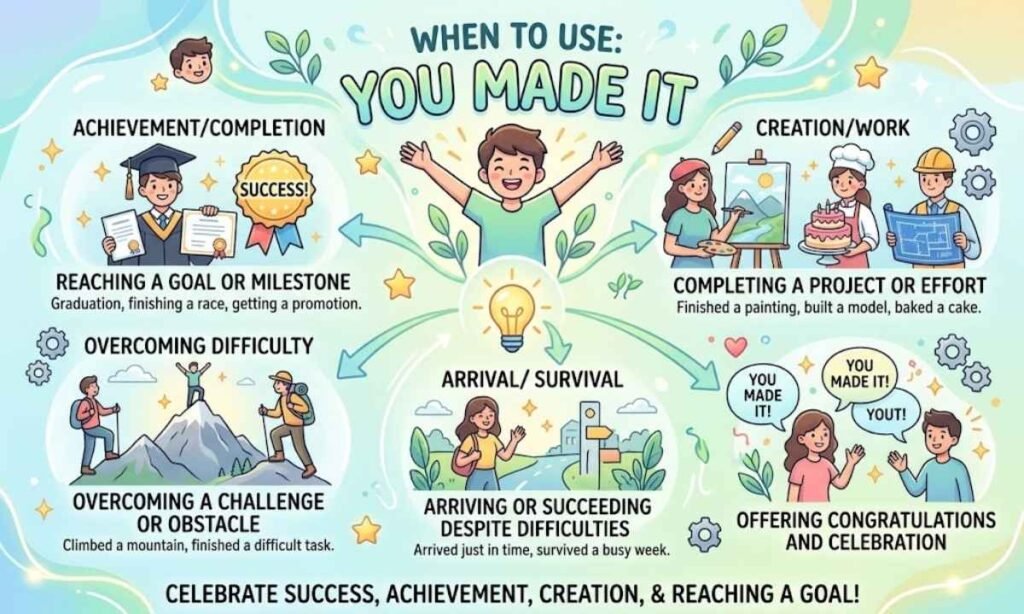
Use “you made it” when someone reaches a destination, hits a milestone, or overcomes obstacles over time. It fits situations involving travel, long term goals, recovery, and survival.
Typical examples include showing up despite traffic, graduating after years of study, recovering from illness, or landing a dream job after multiple attempts. This phrase emphasizes the journey behind the result.
Real Life Examples in Different Contexts
The table below shows how both expressions apply across everyday scenarios.
| Context | You Did It | You Made It |
| School | Passed a tough exam | Got into the honor roll after years of effort |
| Work | Closed a big client deal | Reached ten years at the company |
| Fitness | Finished a workout challenge | Reached your target weight |
| Travel | Not typically used | Arrived at the destination on time |
| Relationships | Fixed a misunderstanding | Made it through a hard year together |
Are You Did It and You Made It Interchangeable
Sometimes yes. When someone overcomes a hard challenge, both phrases can fit, though the emphasis shifts slightly. “You did it” stresses personal effort, while “you made it” stresses survival or arrival at a result. In casual speech, native speakers may use either for general encouragement, but choosing the more accurate one shows stronger command of English.
Cultural and Regional Usage of You Did It and You Made It
American English tends to use “you made it” casually for arrivals, even for something as simple as reaching a party. British English speakers often prefer “well done” alongside “you did it,” reserving “made it” more strictly for travel or survival contexts. Understanding these regional habits helps learners sound more natural depending on the audience.
You Did It and You Made It in Pop Culture and Movies
Both phrases appear often in films, sports commentary, and motivational speeches. “You made it” frequently closes underdog stories about characters reaching fame or safety, while “you did it” is common in scenes celebrating a specific victory, such as winning a race or completing a mission. Recognizing these patterns in media helps learners absorb natural usage.
Common Synonyms and Alternative Congratulatory Phrases
Depending on tone, these alternatives work alongside or instead of the two main phrases.
- Well done
- Nice work
- Congratulations
- You pulled it off
- You nailed it
- You got there
Choosing among these depends on formality and the type of achievement being celebrated.
Common Mistakes to Avoid
Learners often misuse these phrases in predictable ways.
- Saying “you did it” when someone simply arrives somewhere
- Using “you made it” for every finished task, even small ones
- Confusing “made it” with “made it to,” which needs a destination
- Ignoring context and picking a phrase automatically
Paying attention to whether the situation involves a completed action or a reached destination solves most confusion.
Tips for Non Native English Speakers to Remember the Difference
Practice pairing each phrase with a mental category. Assign “did it” to tasks and “made it” to places or milestones. Reading short dialogues, watching interviews, and repeating example sentences aloud builds natural instinct faster than memorizing rules alone.
You Did It vs You Made It in Business and Professional Emails
In workplace communication, “you did it” fits messages praising a completed project, a closed sale, or a solved problem. “You made it” suits emails congratulating someone on a promotion, hitting a performance milestone, or joining the company after a long process. Choosing the right phrase keeps professional messages precise and credible.
Quick Memory Trick
Remember it this way.
Did equals action completed. Made equals a point or goal reached.
If someone finished a task, say “you did it.” If someone arrived somewhere or reached a milestone, say “you made it.”
Frequently Asked Questions
Is You Did It Correct English
Yes, it is a common and grammatically correct phrase used to celebrate completing a task or challenge successfully.
What Does You Made It Mean
It usually means someone arrived somewhere, reached a milestone, or got through a difficult situation successfully.
What Is the Difference Between You Did It and You Made It
You did it focuses on completing an action, while you made it focuses on arriving or reaching a goal.
Is You Made It a Way to Say Congratulations
Yes, it works as a warm congratulatory phrase, especially for arrivals and long term achievements.
Can You Made It Mean You Succeeded
Yes, it can mean success, particularly after a long or difficult journey toward a goal.
Can I Say You Did It When Someone Arrives
It is uncommon. You made it fits arrivals better since it emphasizes reaching a place.
Which Is Better You Did It or You Made It
Neither is better overall. The right choice depends on whether you are praising a finished task or an arrival.
Conclusion
Both “you did it” and “you made it” celebrate success, but the right choice depends on context.
Use “you did it” for completed tasks and personal achievements, and “you made it” for arrivals, milestones, and overcoming challenges. With practice, choosing the natural phrase becomes automatic.