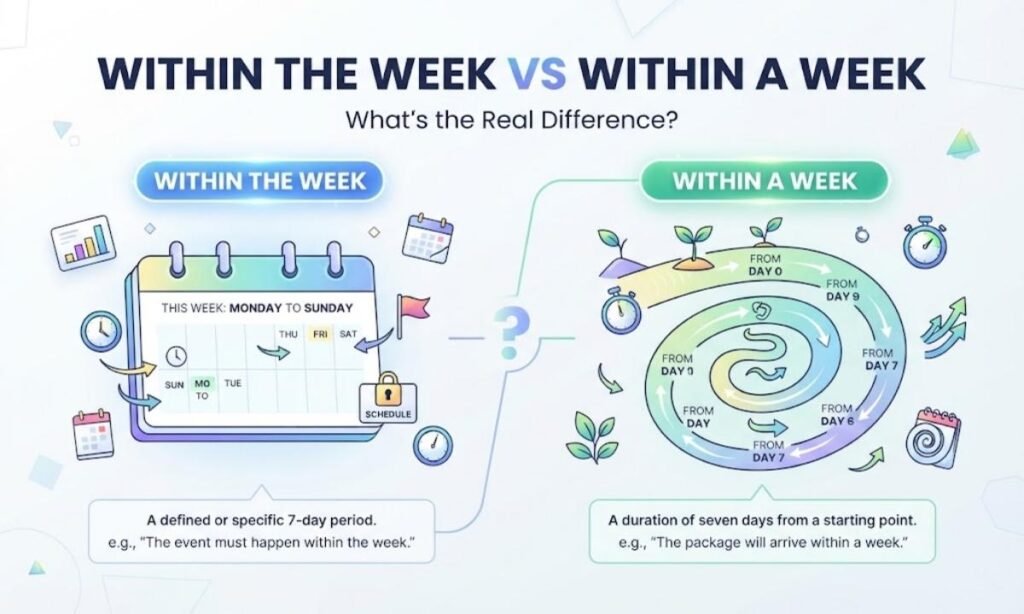
Most people use “within the week” and “within a week” as if they mean the same thing, but they don’t always line up. One usually points to the current calendar week, while the other points to a rolling seven day window that starts the moment you say it. That small gap in meaning can quietly cause missed deadlines, awkward emails, and mixed signals with clients or coworkers.
This guide breaks down both phrases in plain American English, shows how native speakers actually use them, and gives you clear alternatives for moments when precision matters more than style. By the end, you will know exactly which phrase fits your situation and how to avoid the most common mix-up.
Within the Week vs Within a Week at a Glance
| Phrase | Usual Meaning | Time Frame | Example |
| Within the week | Before the current or stated week ends | The present calendar week | “I’ll finish it within the week.” |
| Within a week | No later than seven days from now | A rolling seven day period | “I’ll finish it within a week.” |
The short version: “within the week” is tied to a specific week on the calendar, while “within a week” is tied to a fixed length of time, no matter what day it starts.
What Does Within the Week Mean?
“Within the week” generally signals that something will happen before the current week wraps up. If someone says this on a Wednesday, the listener typically expects the task to be done by Sunday night, not the following Wednesday.
Say a coworker tells you, “I’ll send the report within the week.” Most listeners assume the report lands before the weekend, since the reference point is the week already in progress. This reading lines up with how major dictionaries describe the phrase, treating it as shorthand for finishing before the current week closes out.
That said, the phrase is not airtight. In casual speech, some speakers stretch it to mean “sometime in the next seven days,” which blurs the line with its counterpart. Context, tone, and industry norms all shape how a listener will interpret it.
Common settings where you’ll hear “within the week”:
- Workplace status updates and project check ins
- School assignment reminders from teachers
- Customer service follow up emails
- Everyday plans between friends or family
- Vendor and supplier communication
What Does Within a Week Mean?
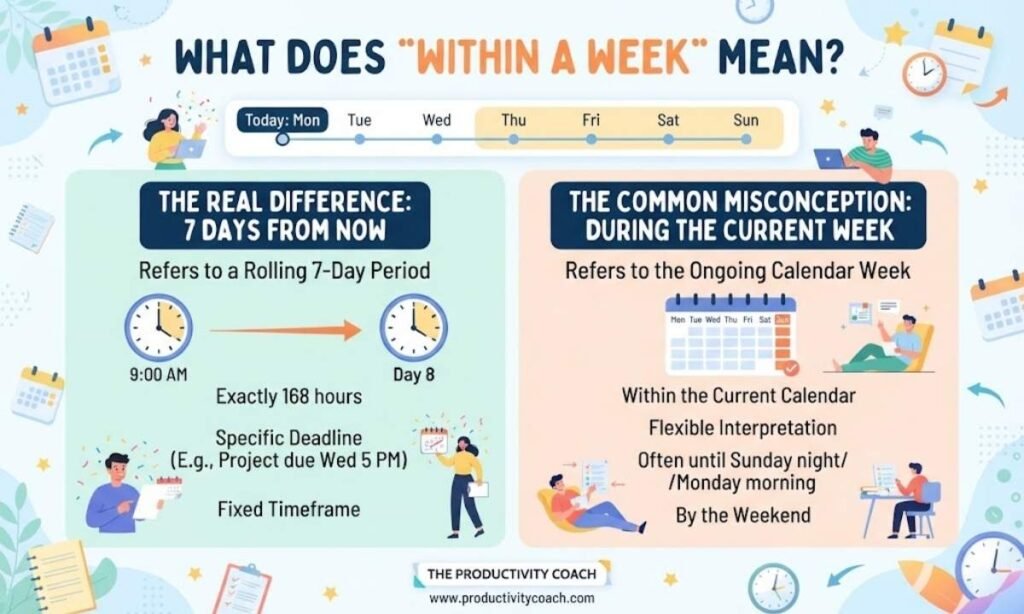
“Within a week” describes a maximum stretch of seven days measured from the moment the statement is made. It doesn’t care which day of the week it is; it only cares about the countdown.
For example, “You should receive a reply within a week” means the reply could arrive tomorrow, in three days, or on day seven, but not later than that. The starting point is flexible, while the outer limit is fixed.
This phrase does not require exactly seven days to pass. It simply sets an upper boundary, and anything that happens before that boundary still satisfies the promise. That flexibility is part of why it shows up so often in customer service and shipping language.
Typical scenarios for “within a week”:
- Package deliveries and shipping confirmations
- Medical or service appointment scheduling
- Freelance and contract work deadlines
- Job application and interview follow ups
- Standard reply time commitments in support tickets
Side by Side Examples You Can Compare
Seeing both phrases in matching sentences makes the contrast easier to remember.
“I’ll call you within the week.” This suggests the call happens before the present week ends, tying the promise to today’s calendar page rather than a fixed countdown.
“I’ll call you within a week.” This points to a seven day window starting right now, so the call could land next Monday even if today is a Tuesday.
“The work will be finished within the week.” Here, the reference week matters most. If it’s already Thursday, the deadline is tight because only a few days remain.
“The work will be finished within a week.” This resets the clock entirely, giving a full seven days no matter which day the promise was made.
Is Within the Week Grammatically Correct?
Yes, “within the week” follows standard English structure. It combines the preposition “within,” the definite article “the,” and the noun “week,” which mirrors other common time expressions like “within the hour” or “within the month.”
The grammar isn’t the issue; the ambiguity is. Readers sometimes can’t tell if the speaker means the current calendar week or a general seven day stretch, especially in written communication without tone or context to guide them. This is exactly why some grammar resources recommend swapping it out in professional writing when precision counts.
Is Within a Week Grammatically Correct?
“Within a week” is also grammatically sound. It follows the pattern of “within” plus an indefinite article and a noun, similar to “within a month” or “within a year.” Because “a week” refers to a general span rather than a specific calendar week, this phrase reads as more universally clear across different audiences and time zones.
Which One Should You Use?
Choose based on what you actually mean, not which phrase sounds more polished.
- Use “within the week” when your deadline is tied to the current week on the calendar.
- Use “within a week” when you’re promising a seven day turnaround starting today.
- Use “by Friday” or a specific date when the stakes are high and ambiguity isn’t an option.
Within the Week vs This Week
“This week” is often the more natural choice in casual American English. Saying “I’ll get it done this week” sounds direct and conversational, while “within the week” can feel slightly more formal or clipped in everyday chat. Both point to the same general window, but “this week” tends to read as friendlier in texts and quick messages.
Within the Week vs By the End of the Week
“Within the week” carries more flexibility because it doesn’t lock in an exact day. “By the end of the week” removes that guesswork and usually points straight to Friday or Sunday, depending on the workplace calendar. For emails where a client needs a firm date, “by the end of the week” is the safer, clearer pick.
Within a Week vs In a Week
These two look similar but lean in different directions. “Within a week” emphasizes a deadline or upper limit, meaning anytime up to seven days counts as on time. “In a week” leans toward a specific future point, closer to “seven days from now” as a target moment rather than a range.
Compare: “I’ll finish it within a week” reads as a promise with room to spare. “I’ll finish it in a week” reads as an expected completion date around the seven day mark.
Within One Week vs Within a Week
These phrases are generally interchangeable in meaning. “Within one week” tends to show up in formal writing such as contracts, policies, and legal notices, where numeric precision feels appropriate. “Within a week” remains the more natural, conversational choice for everyday speech and casual writing.
Regional Differences Worth Knowing
American English leans toward “within the week” in business contexts more than some other English varieties, where speakers might default to “this week” or a specific date instead. If you’re writing for a mixed international audience, swapping in an exact day removes any regional guesswork entirely.
How the Wrong Phrase Creates Real Confusion?
Picture a Wednesday email that reads, “Your refund will process within the week.” A reader might expect the refund by Sunday. Another reader might assume seven days from Wednesday. That gap, multiplied across hundreds of customer emails, turns into support tickets and frustrated follow ups. Precise phrasing prevents that entire chain of confusion before it starts.
Choosing the Right Phrase for Business Writing
Contracts, invoices, and formal notices benefit from stricter language. Swap vague time phrases for specific dates or exact day counts whenever a missed expectation could cause a dispute. Save the more relaxed phrasing for internal chats, casual updates, and low stakes conversations where a day or two of wiggle room won’t matter.
Common Mistakes to Avoid
- Saying “within this week” when “this week” alone sounds more natural
- Using “by this week” when “by the end of this week” is what you actually mean
- Mixing up “within a week” with “in a week” and assuming they’re identical
- Assuming “within the week” always equals a strict seven day count
- Reaching for a vague time phrase when a hard deadline actually matters
Better Alternatives to Within the Week
- This week
- Sometime this week
- Before the end of the week
- By the end of the week
- By Friday
Better Alternatives to Within a Week
- Within seven days
- Before seven days have passed
- In the next seven days
- No later than seven days from now
- By this time next week
Quick Reference Cheat Sheet
| If you mean… | Say this |
| Before the current week ends | Within the week or this week |
| A seven day countdown starting now | Within a week or within seven days |
| A firm, non negotiable date | By Friday or a specific calendar date |
| Formal contract language | Within one week or within seven business days |
Real Life Examples Across Situations
In the workplace, a manager might say, “Submit your timesheet within the week,” expecting it before Friday’s close. In an email, a business could write, “Your invoice will be sent within a week,” setting a seven day window from the send date. In customer service, “Your refund should appear within a week” reassures a customer without pinning down an exact day. In schools, a teacher’s note that says “essays are due within the week” ties the deadline to the current five day stretch. In shipping, “your order will arrive within a week” is standard language across most delivery confirmations.
Frequently Asked Questions
Is within the week correct English?
Yes, it’s grammatically correct, though it can sound ambiguous without added context.
What is the difference between within the week and within a week?
One ties to the current calendar week, while the other means any time within the next seven days.
Does within a week mean seven days?
It means no later than seven days, not necessarily exactly seven days.
Does within the week mean this week?
Yes, it usually points to completing something before the present week ends.
Is within the week formal?
It works in both casual and professional contexts, though some guides suggest avoiding it when clarity is critical.
Is within a week better than in a week?
Within a week sets a clear upper limit, while in a week points more toward an expected future moment.
Can I say within this week?
You can, but “this week” alone usually sounds more natural and less repetitive.
Conclusion
Within the week generally points to the current or specified week. Within a week generally means a seven day maximum starting now. By the end of the week gives a clearer deadline when you mean the current week specifically, and within seven days is the clearest option when you want zero ambiguity.
Choose based on what you actually need your reader to understand, and when the stakes are high, skip the vague phrase entirely and name the exact day.