Ever paused mid-sentence wondering whether to write tomatoes or tomatos? You’re not alone. This tiny spelling question trips up native speakers, students, and even professional writers on a regular basis.
The good news is that the rule is simple once you understand it. In this guide, we’ll break down the correct spelling, explain why English forms this plural the way it does, and give you memory tricks so you never second-guess yourself again.
What Is the Correct Spelling: Tomatoes or Tomatos?
Tomatoes is correct. Tomatos is a misspelling with no accepted use in standard English writing.
Why Do People Write Tomatos by Mistake?
Many nouns ending in “o” simply add “s” for the plural, so writers assume tomato follows the same pattern. It doesn’t.
Is Tomato Singular or Plural?
Tomato is singular, referring to one fruit. Tomatoes is the plural, referring to two or more.
Tomato vs Tomatoes: Understanding the Basic Difference
The difference between these two words comes down to number. Tomato always refers to a single item, while tomatoes refers to multiple items. This distinction matters in recipes, grocery lists, essays, and everyday conversation, since mixing them up can make writing look careless even when the meaning is still clear.
| Word | Grammatical Role | Example Sentence |
| Tomato | Singular noun | The tomato on the counter is ripe. |
| Tomatoes | Plural noun | The tomatoes on the counter are ripe. |
| Tomatos | Incorrect spelling | Never use this form in writing. |
The Grammar Rule Behind Tomato Becoming Tomatoes
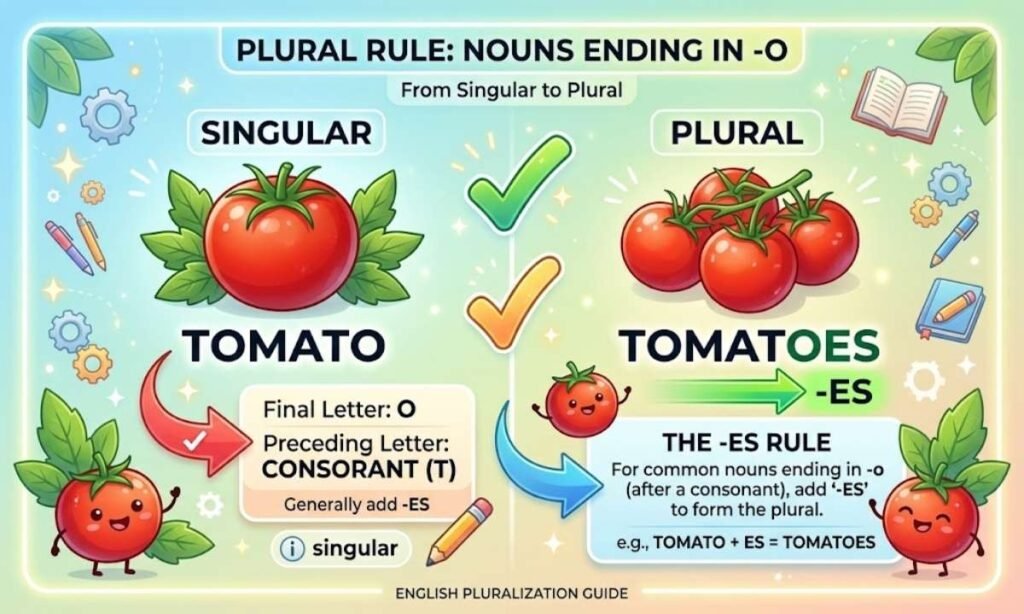
English plural formation usually just tacks on an “s.” But certain nouns ending in a consonant plus “o” instead take “es.” Tomato falls into this category, alongside words like potato, hero, and echo. The extra “e” exists partly for pronunciation reasons, helping the word flow naturally when spoken aloud, and partly because these spellings became standardized over centuries of usage.
This rule isn’t universal across every “o” word, which is exactly why confusion happens so often. English is full of inconsistencies borrowed from Latin, Italian, Spanish, and other source languages, and plural formation is one of the areas where those inconsistent roots show up clearly.
Where Does the Word Tomato Come From?
The word tomato traces back to the Nahuatl word “tomatl,” used by the Aztecs in Mexico. When Spanish colonizers encountered the fruit, they adapted it into Spanish as “tomate,” and the word eventually entered English in the early 1600s. Because the word arrived through Spanish rather than following native English patterns, its plural ended up following the “-es” convention common to many Spanish-derived and consonant-plus-o English nouns rather than a simple “-s” ending.
Understanding this origin helps explain why the spelling feels slightly irregular compared to more straightforward English nouns.
Do All Words Ending in O Take Es in the Plural?
No, and this is where a lot of writers go wrong. Some nouns take “-es,” while others only need “-s.” There’s no single rule that covers every case, so familiarity and memorization matter here.
Words That Use -es
• tomato → tomatoes
• potato → potatoes
• hero → heroes
• echo → echoes
• volcano → volcanoes
Words That Use -s
• photo → photos
• piano → pianos
• radio → radios
• video → videos
• logo → logos
A helpful pattern to notice: many musical or foreign-origin loanwords (piano, photo, radio) tend to take just “-s,” while older, more embedded English words tend to take “-es.” It’s not a perfect system, but it gives you a useful starting instinct.
Tomato, Tomatoes, Tomato’s, and Tomatoes’: Clearing Up the Confusion
Apostrophes add another layer of confusion to this word. Here’s how each form works:
| Word Form | Meaning | Example |
| Tomato | One item | This tomato is fresh. |
| Tomatoes | Multiple items | These tomatoes are fresh. |
| Tomato’s | Belonging to one tomato | The tomato’s color is deep red. |
| Tomatoes’ | Belonging to multiple tomatoes | The tomatoes’ flavor was intense. |
A common mistake is using an apostrophe to make a word plural, such as writing “tomato’s” when you mean multiple tomatoes. Apostrophes show possession or contraction, never plain plurals, in standard English grammar.
Tomatoes in American and British English
Good news for anyone writing across different English dialects: the spelling doesn’t change based on region.
Is the Spelling the Same in the UK and US?
Yes. Both American and British English use tomatoes as the correct plural spelling.
Does Pronunciation Affect Spelling?
No. Americans typically say “toh-MAY-toh” while British speakers often say “toh-MAH-toh,” but the written form stays identical.
Tomato Facts Worth Knowing
Beyond grammar, tomatoes carry some genuinely interesting trivia that makes for useful supporting content:
• Botanically, a tomato is classified as a fruit, specifically a berry, though it’s legally treated as a vegetable in some countries for tariff and culinary purposes.
• Tomatoes are members of the nightshade family, related to potatoes, peppers, and eggplants.
• There are thousands of tomato varieties grown worldwide, ranging from tiny cherry tomatoes to large beefsteak types.
• Tomatoes are a major source of lycopene, an antioxidant linked to several health benefits.
• The largest tomato-growing countries include China, India, and the United States.
Tomatoes vs Other Confusing English Plurals
Tomatoes isn’t the only word that causes plural confusion. Several everyday nouns follow irregular or unexpected patterns:
• Mango → mangoes or mangos (both are widely accepted)
• Cactus → cacti or cactuses
• Fungus → fungi or funguses
• Mosquito → mosquitoes or mosquitos (both are used, though “mosquitoes” is more traditional)
Comparing tomatoes to these examples shows that English plural rules are rarely absolute, and checking a dictionary is always a safe habit when a word feels uncertain.
How Dictionaries and Style Guides Define the Correct Form?
Major dictionaries, including Merriam-Webster and the Oxford English Dictionary, list tomatoes as the only standard plural form. Style guides used in journalism, academic writing, and professional publishing consistently follow this same standard, with no regional or stylistic exceptions noted. This consistency across authoritative sources is exactly why tomatos is considered a spelling error rather than an alternate accepted form.
How to Remember the Correct Spelling?
A few simple memory tricks can lock this spelling in permanently:
1. Pair it with potato. If you remember potatoes takes an “e,” tomatoes follows the identical pattern.
2. Say it out loud. The extra syllable created by the “e” mirrors how the word is naturally pronounced.
3. Picture the phrase “one tomato, two tomatoes” as a fixed unit, the same way you’d memorize any vocabulary pair.
4. Remember that spell-checkers will almost always flag “tomatos” as an error, so trust that red underline.
Using Tomatoes Correctly in Everyday Writing
This word shows up constantly in daily communication, so getting it right matters more than it might seem:
• Recipes: “Add two cups of chopped tomatoes to the sauce.”
• Grocery lists: “Buy tomatoes, onions, and basil.”
• Gardening notes: “The tomatoes are ready for harvest.”
• School or professional writing: “The tomatoes used in this study were grown organically.”
Consistently using the correct spelling in these contexts builds credibility, whether you’re writing a blog post, a school assignment, or a business document.
Quick Grammar Checklist Before You Publish
Before finalizing any piece of writing that mentions this word, run through this short checklist:
• Confirm you meant plural, not possessive (tomatoes, not tomato’s)
• Double-check the spelling includes the “e” before “s”
• Read the sentence aloud to catch awkward phrasing
• Run a spell-check as a final safety net
• Compare against a trusted dictionary if you’re still unsure
Frequently Asked Questions
Is it tomatoes or tomatos?
Tomatoes is correct. Tomatos is a common misspelling with no standard acceptance.
What is the plural of tomato?
The plural of tomato is tomatoes, formed by adding “-es” instead of just “-s.”
Why does tomato become tomatoes instead of tomatos?
English adds “-es” to many nouns ending in a consonant plus “o,” and tomato follows this pattern.
Is tomatos ever considered correct?
No, tomatos is not recognized as correct in any major dictionary or style guide.
Is tomato singular or plural?
Tomato is singular; tomatoes is the plural form used for two or more.
Does the spelling change between American and British English?
No, both dialects use the identical spelling: tomatoes.
What’s the difference between tomato’s and tomatoes?
Tomato’s shows possession for one tomato, while tomatoes simply means more than one.
Do all words ending in “o” use “-es” for plurals?
No, some use “-es” like tomatoes, while others use “-s” like photos and pianos.
How can I remember the correct spelling permanently?
Link it to “potatoes,” since both words follow the exact same “-es” pattern.
Where does the word tomato originally come from?
It comes from the Nahuatl word “tomatl,” later adapted through Spanish into English.
Conclusion
Tomatoes is the only correct plural spelling of tomato, accepted across American English, British English, dictionaries, and professional style guides. Tomatos is simply an error, usually caused by applying the more common “-s” plural rule to a word that requires “-es” instead.
Remember it this way: one tomato, two tomatoes, always with the “e.”