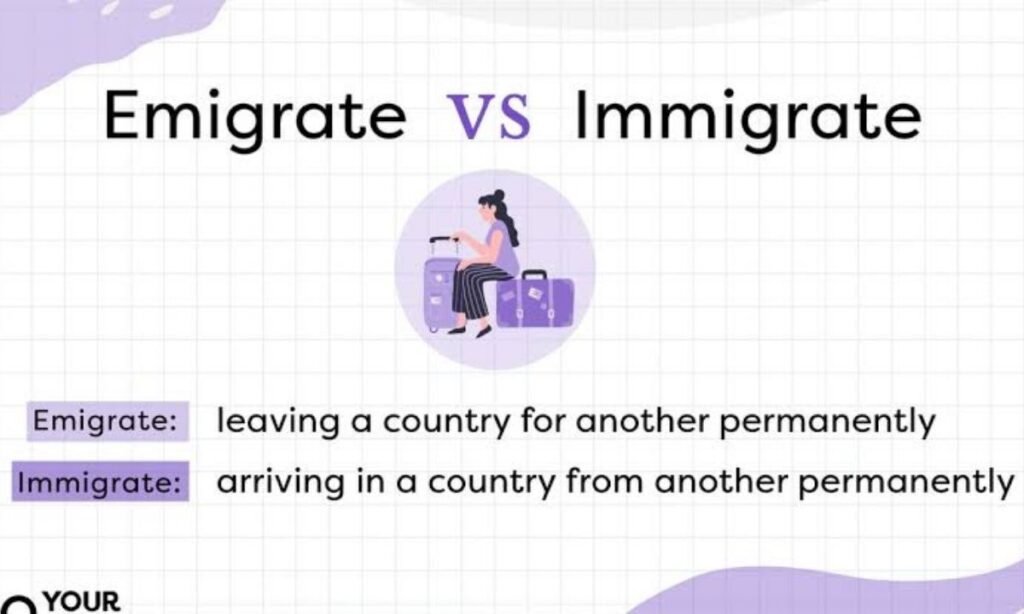
Moving to a new country is a big step, and the words you use to describe it matter. Many writers pause at the same point: emigrate or immigrate? Both verbs describe the same journey, yet each one looks at it from a different side.
This guide gives you a clear answer first, then walks through meanings, prepositions, examples, and memory tricks. You will also see how migrate, emigrant, and immigration fit in. By the end, you can pick the right word with confidence in essays, emails, visa forms, and everyday speech. Every point follows standard dictionary usage.
Emigrate or Immigrate: What’s the Difference?
Emigrate means to leave your home country to live somewhere else. Immigrate means to enter a new country to live there. The same person can do both in one move, depending on which country you are talking about.
Emigrate Means Leaving a Country
The focus is on departure. When you emigrate, you exit the place where you lived. Example: “My grandparents emigrated from Norway.”
Immigrate Means Entering a New Country
The focus is on arrival. When you immigrate, you come into a country and settle there. Example: “She immigrated to Canada in 2019.”
Emigrate vs. Immigrate at a Glance
| Word | Meaning | Common Pattern | Focus |
| Emigrate | Leave a country to live elsewhere | emigrate from | Departure |
| Immigrate | Enter a country to live there | immigrate to | Arrival |
The difference is about perspective. One word looks back at the place left behind. The other looks ahead at the place reached.
When Should You Use “Emigrate”?
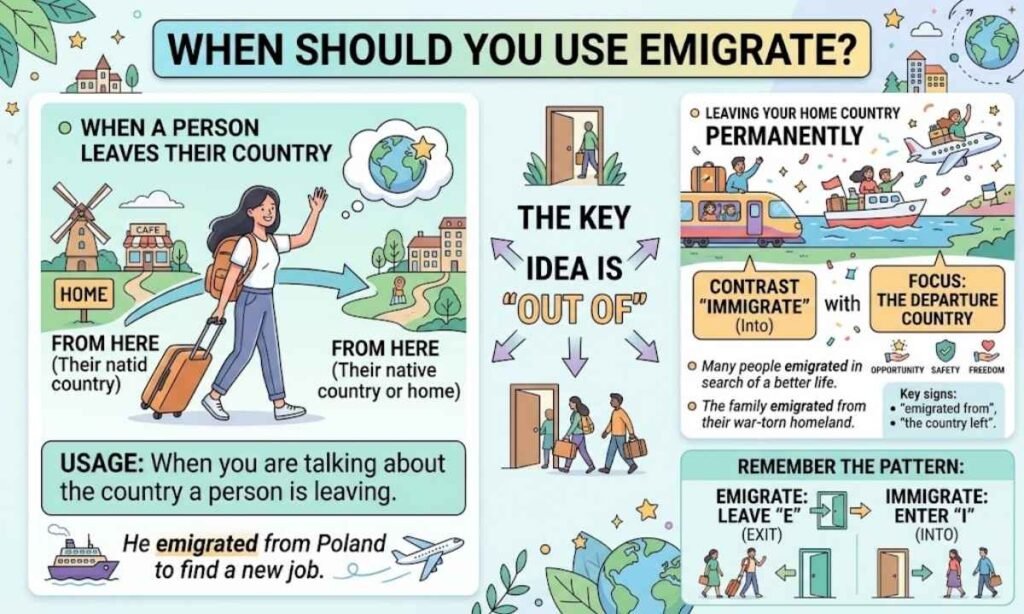
Use emigrate when your sentence centers on the country someone leaves. The verb usually implies a permanent move, and it applies to people.
- Use “emigrate from” with the country of origin.
- Use it when discussing why someone left.
- Use it in historical writing about people who departed in waves.
Examples:
- She emigrated from Mexico.
- His family emigrated from Italy after the war.
- They decided to emigrate from their home country.
Is “emigrate to” correct? Many usage guides advise against it, since the verb points to the place of departure. You will still see it in print, such as “emigrated to America,” especially in older texts. For formal writing, “from” is the safer choice.
When Should You Use “Immigrate”?
Use immigrate when your sentence centers on the country someone enters to live in.
- Use “immigrate to” with the destination.
- Use it when describing settling, working, or applying for residence.
- Use it when the new country is the main subject.
Examples:
- He immigrated to Australia for work.
- Many families immigrate to the United States each year.
- She plans to immigrate to Germany next spring.
Is “immigrate from” correct? Grammar guides generally prefer “immigrate to,” but “immigrated from” does appear when a sentence names the origin as extra detail, such as “She immigrated to the U.K. from Kenya.”
Emigrate From vs. Immigrate To
This is the most practical rule in the whole topic.
- Emigrate from = where you leave
- Immigrate to = where you arrive
Quick rule: emigrate from your old country, immigrate to your new one.
Can You Emigrate and Immigrate at the Same Time?
Yes. One international move can be described both ways. Both words are accurate, because each one names a different country in the story.
Example: “Maria emigrated from Mexico and immigrated to the United States.”
In Mexico, she is an emigrant. In the United States, she is an immigrant. Same person, same move, two viewpoints.
Emigrate or Immigrate Examples
With Emigrate
- Many Irish citizens emigrated during the nineteenth century.
- He emigrated from Italy to Australia.
With Immigrate
- They immigrated to Canada to start a business.
- She immigrated to the U.K. last year.
Both in One Sentence
- My parents emigrated from Bangladesh and immigrated to New York in 1998.
Emigrate vs. Immigrate vs. Migrate
Migrate is the broader word. It means to move from one place to another, and it does not require crossing a national border. Animals migrate, and so do people who relocate within a country.
| Word | Meaning | Crosses a Border? | Example |
| Emigrate | Leave a country | Yes | She emigrated from Peru. |
| Immigrate | Enter a country | Yes | She immigrated to Spain. |
| Migrate | Move from place to place | Not required | Birds migrate south in winter. |
Choose migrate for general movement, emigrate for leaving, and immigrate for arriving.
Emigrant vs. Immigrant: What’s the Difference?
An emigrant is a person who leaves a country to settle in another. An immigrant is a person who comes into a country to live there.
The same individual can be both. The label depends on whose point of view you take. Since these nouns rarely come with “from” or “to,” context usually tells the reader which one you mean.
Immigration vs. Emigration
- Emigration is the act or process of leaving a country to live elsewhere.
- Immigration is the act or process of entering a country to settle there.
In simple terms, emigration is about people going out, and immigration is about people coming in. When a country reports both, it tracks the outflow and inflow of residents.
How to Remember the Difference Between Emigrate and Immigrate?
Three simple tricks help.
- E for Exit. Emigrate and exit both start with E.
- I for In. Immigrate and into both start with I.
- From and To. Emigrate goes with from. Immigrate goes with to.
Word Origins and Prefixes Explained
Both words come from Latin roots tied to the verb for moving. The difference sits in the prefix. The prefix “e” is a short form of “ex,” meaning out of or from. The prefix “im” is a form of “in,” meaning into.
That is why the meanings line up with direction: out for emigrate, in for immigrate. Knowing the roots also helps with related words like exit, export, import, and implant.
Why People Emigrate: Push and Pull Factors?
Researchers who study migration often describe two forces.
- Push factors drive people away: economic hardship, conflict, political instability, or natural disasters.
- Pull factors attract people to a new place: better jobs, education, safety, or family ties.
The same forces explain both terms. Push factors shape emigration from a country. Pull factors shape immigration into another.
Do Emigrate and Immigrate Apply to Moving Within a Country?
No. Both verbs need an international move. If someone relocates from one city or state to another inside the same country, the correct word is migrate or simply “move” or “relocate.”
Example: “Many families migrate south for the winter” works. “They emigrated to another state” does not.
Common Mistakes With Emigrate and Immigrate
- Using emigrate when you mean arrive.
- Using immigrate when you mean leave.
- Mixing up from and to.
- Treating the two words as exact synonyms.
- Using either verb for movement inside one country.
Wrong: “He immigrated from France to Japan.”
Better: “He emigrated from France to Japan” or “He immigrated to Japan from France.”
Emigrate or Immigrate: Quick Grammar Test
Ask yourself one question.
- Are you talking about leaving? Choose emigrate.
- Are you talking about entering? Choose immigrate.
- Are you talking about movement in general? Choose migrate.
Practical Tips for Writers and Language Learners
These habits come from common editing practice and help keep your writing accurate.
- Decide which country your sentence focuses on before choosing the verb.
- Pair the verb with its usual preposition and check that it sounds natural.
- Read your sentence aloud. If “leave” fits, use emigrate. If “arrive” fits, use immigrate.
- When unsure, check a trusted dictionary such as Merriam Webster or Oxford.
Frequently Asked Questions
What Is the Difference Between Emigrate and Immigrate?
Emigrate means to leave a country to live elsewhere. Immigrate means to enter a country to live there.
Is It Emigrate From or Emigrate To?
Emigrate from is the standard form, since the verb points to the place left behind. “Emigrate to” appears in older writing but is less preferred.
Is It Immigrate To or Immigrate From?
Immigrate to is the standard form because it names the destination. “Immigrate from” is acceptable only when the origin is added as extra detail.
Can the Same Person Emigrate and Immigrate?
Yes. One move can be described with both verbs, depending on which country you mention.
What Is an Easy Way to Remember Emigrate vs. Immigrate?
Think E for Exit and I for In. Emigrate exits a country, and immigrate goes into one.
Is Migrate the Same as Immigrate?
No. Migrate is a broader word for moving from place to place, with no border crossing required. Immigrate specifically means entering another country to live.
What Is the Difference Between Emigrant and Immigrant?
An emigrant leaves a country, and an immigrant arrives in one. A single person can be both.
Conclusion
Emigrate and immigrate describe the same journey from opposite ends. Emigrate looks at the country someone leaves, and immigrate looks at the country someone enters. Keep the rule handy: emigrate from, immigrate to.
If you ever feel stuck, use the E for Exit and I for In trick, or switch to migrate when the border does not matter. With these habits, the choice becomes quick and automatic.