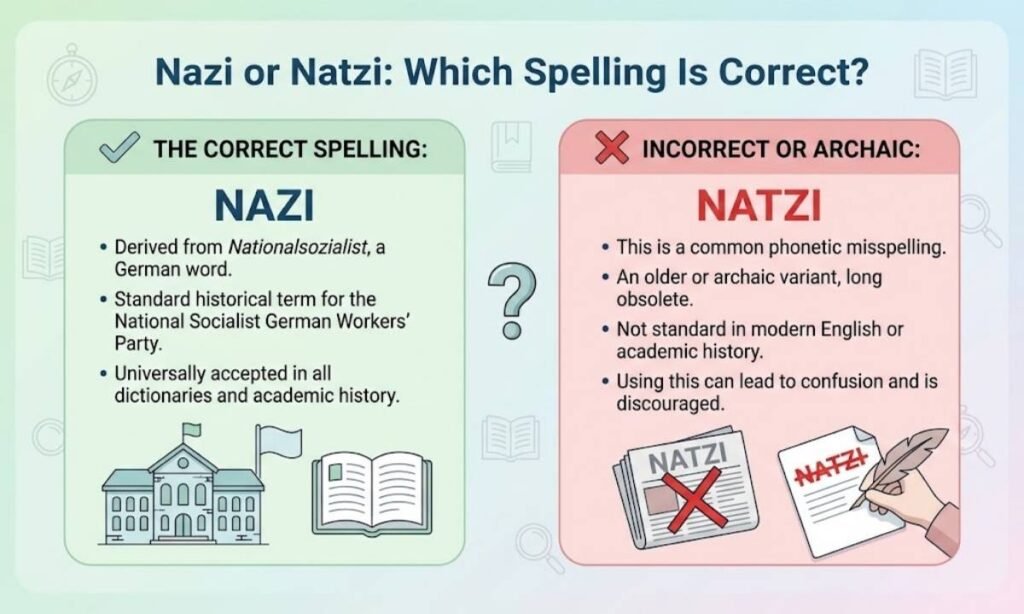
Many people search online for “Natzi or Nazi” simply because the word sounds that way when spoken aloud. This mix-up is common, and it happens across search engines, social media captions, and even school essays, which is why the confusion keeps repeating itself year after year.
The correct English spelling is Nazi, not Natzi. Nazi is the term recognized by major dictionaries and historical sources, while Natzi is treated as a phonetic misspelling with no accepted standing in English.
Understanding the Correct Spelling of Nazi
Nazi is spelled N, A, Z, I. There is no T anywhere in the written form, even though many speakers hear a T sound when the word is pronounced. Dictionaries such as Merriam Webster, Collins and Cambridge all list the same four letter spelling, and none of them recognize Natzi as an alternate or informal form.
This matters for students, writers and content creators because search engines and grammar checkers will flag Natzi as an error. If you are producing academic, journalistic or historical content, sticking with the standard spelling protects your credibility and keeps your writing aligned with recognized reference sources.
Why Natzi Is Not a Recognized English Word?
Natzi does not appear in any major dictionary, whether print or digital. It is not listed as a variant spelling, a regional form or a historical alternative. Linguists classify it as a spelling error that stems from how English speakers process unfamiliar loanwords borrowed from German.
Because the word Nazi entered English from German rather than developing naturally within English, its spelling does not always match its sound. This mismatch is exactly what produces the Natzi error, since writers often default to spelling words the way they hear them rather than the way they are formally recorded.
The Pronunciation Behind the Natzi Confusion
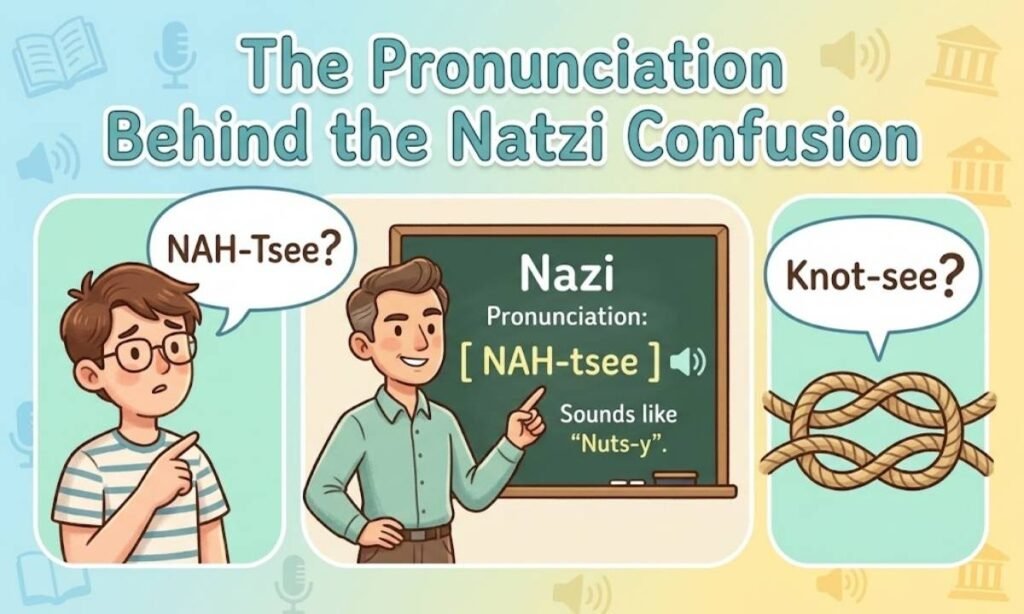
According to Cambridge Dictionary, the American pronunciation of Nazi is written as /ˈnɑːt.si/, and the British pronunciation follows a closely related pattern. That embedded T sound between the first and second syllables is the real source of the confusion, since listeners hear “naht see” and assume the spelling must include a T.
Wiktionary records three accepted pronunciations for the word: /ˈnɑːtsi/, /ˈnætsi/ and the older, now uncommon /ˈnæzi/. The first two remain in active use, and both contain the same T sound, which explains why the Natzi misspelling shows up so consistently among English learners and native speakers alike.
| Region | IPA Pronunciation | Approximate Sound |
| American English | /ˈnɑːtsi/ | “naht see” |
| British English | /ˈnɑːtsi/ | “naht see” |
| Older / historical form | /ˈnæzi/ | “nat see” (rare today) |
Word Origin and Etymology of Nazi
The word Nazi comes directly from German. It is a shortened, colloquial clipping of Nationalsozialist, meaning National Socialist, the label used for members of the National Socialist German Workers’ Party led by Adolf Hitler. Etymological sources trace the shortened form back to the early 1920s, with wider English adoption following in the early 1930s as coverage of the party’s rise spread internationally.
Interestingly, a similar sounding nickname existed in Bavarian German even before the political party formed. It was used informally as a pet form of the name Ignaz and, separately, as a mildly mocking term for an unsophisticated rural person. Some historians believe that earlier usage may have shaped how quickly the abbreviated political term caught on and how it was received by contemporaries.
Nazi as a Noun and as an Adjective
Nazi functions as both a noun and an adjective in standard English. As a noun, it refers to a member of the historical German political party or, by extension, to a modern follower of neo Nazi or similarly extremist ideology. As an adjective, it describes anything connected to that movement, its government or its policies.
Common noun usage:
● A former Nazi living under a different identity
● Historians studying the rise of the Nazis
Common adjective usage:
● Nazi propaganda
● Nazi occupied territory
● Nazi ideology
Capitalization Rules for Nazi and Nazis
Nazi is capitalized in nearly every context because it functions as a proper adjective and proper noun tied to a specific historical political party. This holds true whether the word appears as a noun (a Nazi), a plural (the Nazis) or an adjective (Nazi Germany). Style guides used by major publishers consistently capitalize the term when referencing the historical party, its members or its era.
A lowercase, informal use does exist in casual slang, where “nazi” is sometimes attached to another word to jokingly describe someone who is extremely strict about a topic, such as a “grammar nazi.” Reference sources note that this informal sense is sometimes considered distasteful, so many careful writers avoid it altogether in professional content.
Nazi Party, Nazism and Nazi Germany Explained
These three related terms are often confused with one another, so it helps to separate them clearly.
| Term | Meaning |
| Nazi Party | The National Socialist German Workers’ Party (NSDAP), the political organization led by Adolf Hitler |
| Nazism | The political ideology and belief system associated with the party, including its totalitarian and racist doctrines |
| Nazi Germany | The period of German history from 1933 to 1945 when the Nazi Party controlled the government |
The Nazi Party held power in Germany from 1933 until the collapse of the regime in 1945. According to the U.S. Holocaust Memorial Museum, this period included widespread propaganda, systemic persecution and the coordinated targeting of Jewish people and other groups the regime deemed undesirable.
How to Use Nazi Correctly in a Sentence?
Using the word correctly in context reinforces the right spelling far better than memorizing rules alone.
Correct sentence examples:
● Museums across Europe document Nazi era artifacts to preserve historical memory.
● The professor’s lecture focused on how the Nazi regime rose to power.
● Survivors have shared personal accounts of life under Nazi rule.
Incorrect sentence examples (using the misspelling):
● “The Natzi regime began in 1933.” (should read Nazi)
● “She researched Natzi propaganda techniques.” (should read Nazi)
Natzi or Nazi Quick Comparison
| Feature | Nazi | Natzi |
| Dictionary recognized | Yes | No |
| Standard English spelling | Yes | No |
| Historical accuracy | Correct | Incorrect |
| Common cause | Not applicable | Phonetic misspelling based on pronunciation |
| Recommended usage | Always | Never |
Common Typing Mistakes That Lead to Natzi
Several patterns explain why Natzi shows up so often in searches and casual writing.
● Speakers type the word phonetically because the pronunciation contains a clear T sound
● English learners assume foreign loanwords follow English spelling logic
● Autocorrect and voice to text tools sometimes fail to catch the error since Natzi still resembles a plausible English word
● Fast typing on mobile keyboards increases the odds of inserting an extra letter
Recognizing these patterns helps writers slow down and double check unfamiliar loanwords before publishing.
Frequently Asked Questions
Is Natzi a real word?
No. Natzi is not found in any standard dictionary and is considered a misspelling of Nazi.
How do you spell Nazi correctly?
Nazi is spelled N, A, Z, I, with no T included anywhere in the written word.
Why does Nazi sound like it has a T in it?
Both American and British pronunciation include a T sound between syllables, which is why listeners often assume the spelling matches.
Is Nazi always capitalized?
Yes in nearly all formal and historical contexts, though an informal slang sense is sometimes written lowercase.
What is the plural of Nazi?
The plural form is Nazis, formed by adding an S, with no change to the root spelling.
What is the difference between Nazi and Nazism?
Nazi refers to a member of or something related to the party, while Nazism refers to the underlying political ideology itself.
Where does the word Nazi come from?
It comes from the German word Nationalsozialist, shortened informally into Nazi during the early twentieth century.
Conclusion
Nazi is the correct and only recognized English spelling. Natzi is a common phonetic misspelling that appears because the pronunciation of Nazi includes a T sound that is not reflected in its written form.
Whether you are writing about the historical Nazi Party, Nazi Germany or the broader ideology of Nazism, using the standard four letter spelling keeps your content accurate, credible and aligned with how dictionaries and historical sources record the term.