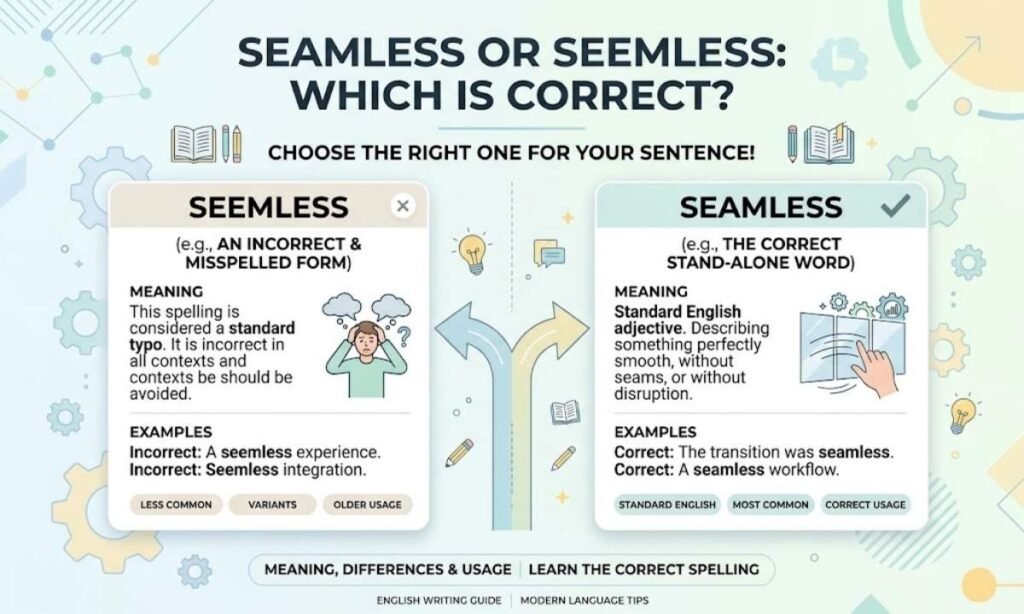
Seamless is the correct spelling when you mean smooth, continuous, or free of visible joins. Seemless is almost always a typo in modern writing, usually caused by confusing seam with the common verb seem. The two words sound identical, so the mistake is easy to make and easy to miss. Read on for the quick answer, the reason behind it, and one rare exception.
This guide explains what each spelling means, why seamless uses the letters “sea,” and how to use seamless, seamlessly, and seamlessness correctly. You will also find sentence examples, notes on US and UK English, and simple memory tricks that make the right spelling stick.
Seamless vs. Seemless: The Quick Answer
Seamless is the correct modern spelling for something smooth, continuous, or made without seams. Seemless is normally a misspelling today. The only exception is an archaic word found in some historical dictionaries, where it meant unbecoming or unseemly. For everyday writing, business copy, and school work, always choose seamless.
| Word | Status | Meaning | Use it today? |
| Seamless | Correct | Without seams; smooth and continuous | Yes |
| Seemless | Misspelling in modern use | Archaic: unseemly or unbecoming (rare) | No |
| Seamlessly | Correct adverb | In a smooth, uninterrupted way | Yes |
| Seemlessly | Incorrect | Not a standard word | No |
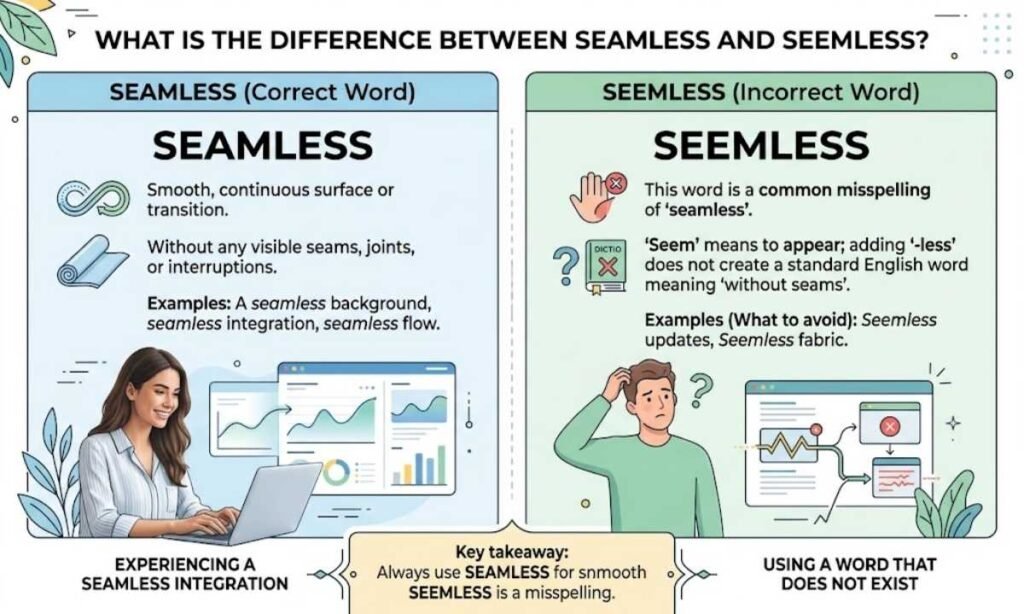
What Is the Difference Between Seamless and Seemless?
Seamless Means Smooth, Continuous, or Without Seams
The literal meaning of seamless is “having no seams.” A seamless garment, pipe, or wall has no visible line where two pieces were joined. Seamless fabric, for example, is knitted or finished so there are no stitched lines to feel or see.
The figurative meaning grew from that picture. A seamless process flows from one step to the next without gaps, delays, or awkward breaks. In modern English, you will see the word most often in this second sense, in technology, travel, customer service, and design.
Seemless Is Not the Modern Spelling for “Smooth”
In current English, writers who type seemless are nearly always aiming for seamless and slipping on the spelling. Style guides, spell checkers, and editors treat it as an error, and it can make professional writing look careless.
Some historical dictionaries do list seemless as an obsolete word meaning unseemly, which is the opposite of seemly or fitting. That old sense has nothing to do with smoothness. It is not part of everyday vocabulary, so do not use it to defend the modern misspelling.
Why Is Seamless Spelled With “Sea”?
Seam + -less Explains the Correct Spelling
The spelling follows simple word building. Seam is the noun for the line where two pieces of material are joined. The suffix -less means “without.” Put them together and you get seamless, meaning without seams.
- Seam: a joining line, as in a sewn or welded edge
- -less: without, as in careless or endless
- Seamless: without seams
Once you see the parts, the “sea” in the middle stops looking odd. It is simply the spelling of seam.
Why “Seem + -less” Looks Correct but Is Wrong Today
Seem is a very common verb that means “to appear” or “to give the impression of.” Because readers see it constantly, it feels natural to reach for that spelling when they hear the word in speech.
The problem is meaning. If seamless were built from seem, it would suggest “without appearing,” which makes no sense for a smooth surface or a smooth experience. Seam and seem sound alike but belong to different ideas: one is about joining, the other is about appearance.
Seamless vs. Seemless Pronunciation
Do Seamless and Seemless Sound the Same?
Yes. Both are normally pronounced “SEEM-less,” with the same long “ee” sound. That makes them homophones in practice, which is exactly why the error spreads.
Hearing a word tells you how to say it, not how to spell it. English has many spellings for the same vowel sound, so you cannot trust your ear here. When in doubt, check the meaning, not the sound.
Seamless, Seamlessly, and Seamlessness
The word has three common forms, and each one keeps the “sea” spelling.
- Adjective: seamless (a seamless transition)
- Adverb: seamlessly (the system works seamlessly)
- Noun: seamlessness (the seamlessness of the design)
The form seemlessly is a very common incorrect spelling of the adverb. If you mean “in a smooth, uninterrupted way,” write seamlessly.
How to Use “Seamless” Correctly in a Sentence?
Literal Examples of Seamless
Use seamless in its physical sense when you describe objects with no visible joins.
- She wore a seamless bodysuit under her dress.
- The tailor chose a seamless fabric for the lining.
- The countertop has a seamless surface with no gaps.
- The plumber installed a seamless pipe to prevent leaks.
- The wall was repaired so well that the join looked seamless.
Figurative Examples of Seamless
Use seamless in its figurative sense when something runs smoothly with no interruptions.
- The new app offers a seamless experience across phone and laptop.
- The team handled the seamless transition to the new manager.
- The software promises seamless integration with your existing tools.
- A seamless process saves time for both staff and customers.
- Clear updates made communication between departments seamless.
Common Incorrect Sentences and Their Corrections
These short pairs show the typical errors and the fixes.
| Incorrect | Correct |
| The move to the new system was seemless. | The move to the new system was seamless. |
| The two apps work seemlessly together. | The two apps work seamlessly together. |
| We want a seemless customer experience. | We want a seamless customer experience. |
| The dress has a seemless finish. | The dress has a seamless finish. |
| She admired the seemlessness of the design. | She admired the seamlessness of the design. |
Seamless in American and British English
Is Seamless Spelled the Same in US and UK English?
Yes. There is no American or British variation for this word. Unlike color and colour, or organize and organise, seamless is spelled the same on both sides of the Atlantic.
If an editor, teacher, or client asks which version to use, the answer never changes. Seamless is the standard choice in the US, the UK, Canada, Australia, and everywhere else English is written.
Should You Ever Use “Seemless” in Modern Writing?
Almost never. The only legitimate case is quoting or studying an older text where the archaic word appears with its old meaning of unseemly. Outside of that, it will read as a mistake.
A simple rule works for nearly every situation: use seamless when you are describing smoothness, continuity, or the absence of seams. If your sentence fits any of those ideas, seamless is the word you want.
Easy Ways to Remember the Correct Spelling
Use the “No Seams = Seamless” Memory Trick
Tie the spelling to the meaning. If something has no seams, it is seamless. Think of the letters s-e-a-m inside the word as the seam itself, hidden in the middle and then removed by the ending -less.
A quick test also helps. Replace the word with “without seams.” If the sentence still makes sense, spell it with “sea.”
Remember Seam vs. Seem
Keep the two base words apart by their jobs.
- Seam: joining or stitching, as in the seam of a shirt
- Seem: appearing a certain way, as in “it seems fine”
If your word is about joins, use seam. If it is about appearances or impressions, use seem. Seamless is about joins, so it takes “sea.”
Frequently Asked Questions
Is seamless or seemless correct?
Seamless is correct for modern English. Seemless is treated as a misspelling unless it appears as the rare archaic word.
Is seemless a real word?
Only in a historical sense. Some older dictionaries record it as an obsolete word meaning unseemly, but it is not used in everyday English.
Why is seamless spelled with “sea”?
Because it comes from seam plus the suffix -less. Seam is a joining line, so seamless means without seams.
What does seamless mean?
It means having no seams, or flowing smoothly with no breaks. It can describe fabric and surfaces as well as processes, experiences, and transitions.
Is seamless the same in American and British English?
Yes. Both use the same spelling, and no regional variant exists.
Is seamlessly or seemlessly correct?
Seamlessly is correct. Seemlessly is a common misspelling of the adverb.
How do you use seamless in a sentence?
Try “The update gave users a seamless experience” or “The tailor made a seamless hem.” Use it for anything smooth, continuous, or without joins.
Conclusion
The answer is simple: seamless is the correct spelling, and seemless is a modern error. Remember the rule that seam plus -less equals without seams, and the “sea” will always feel right. The only qualification is a rare archaic word meaning unseemly, which has nothing to do with smoothness.
In practice, use seamless, seamlessly, and seamlessness whenever you describe smooth, continuous, or joinless things. If you want a fast check before publishing, swap the word for “without seams.” If it fits, you have the right spelling.