Emasculate is the correct word. Demasculate is a nonstandard form that most writers should avoid. The confusion is understandable, because many English verbs, such as demote and deconstruct, begin with de-. Emasculate follows a different pattern. It comes from Latin, where the prefix e- means “out” or “away.”
This simple guide explains what each term means, how they differ, and when to use each one in school, work, and everyday writing. It also covers pronunciation, synonyms, opposites, and the real but different word demasculinize. Choosing the wrong form can make an otherwise careful sentence look sloppy, so a quick check is always worthwhile.
Emasculate vs Demasculate Comparison Table
| Word | Status | Meaning | Example |
| Emasculate | Standard verb and adjective | To weaken; to make a man feel less masculine; to castrate | The new rules emasculated the oversight board. |
| Demasculate | Nonstandard and rare | A variant of emasculate, usually written by mistake | Avoid it. Write “emasculate” instead. |
| Demasculinize | Real word, more technical | To remove or reduce masculine traits or features | The chemical can demasculinize the behavior of male fish. |
In short, emasculate and demasculate point to the same idea, but only emasculate is standard. Demasculinize is a separate word with a narrower, often technical use.
What Does Emasculate Mean?
Emasculate has a literal sense and several figurative ones. Today, writers use it figuratively far more often than literally.
Meanings of Emasculate
Dictionary.com gives three senses: to deprive one of strength, to make a man feel less masculine, and to castrate. In practice, they look like this:
- To weaken or undermine: Lawmakers can emasculate a bill by stripping out its key provisions.
- To make someone feel less masculine: A man may feel emasculated after being mocked in public.
- To castrate: This is the oldest sense. It is now rare outside veterinary, historical, or technical writing.
- In botany: Plant breeders emasculate a flower by removing its anthers before cross-pollination.
Emasculate Beyond Personal Identity
Emasculate does not have to describe a person. Writers often use it for laws, rules, institutions, and ideas that lose their force. A court can emasculate a regulation, and a new manager can emasculate a department by removing its decision-making power.
This broader sense is useful because it avoids gender entirely. It simply means to take away power or effectiveness.
Tone and Sensitivity
Emasculate is rarely neutral. Vocabulary.com notes that using it to imply a man is not manly can also insult women, since it treats strength and being female as opposites. Many readers notice this, so use the personal sense deliberately. When you only mean “weaken,” choose a more neutral verb.
Emasculate Pronunciation
In American English, the verb is pronounced ih-MASS-kyuh-layt, with the stress on the second syllable. Wiktionary also records a General American variant that begins with an “ee” sound. The adjective can end more softly, closer to “-lut” than “-layt.”
Related Word Forms: Emasculate
| Form | Part of speech | Example |
| emasculate | Verb, adjective | They tried to emasculate the proposal. |
| emasculates | Verb (present, third person) | The ruling emasculates the agency. |
| emasculated | Verb (past), adjective | The emasculated policy changed very little. |
| emasculating | Verb (present participle), adjective | He found the remark emasculating. |
| emasculation | Noun | The emasculation of the law was complete. |
| emasculator | Noun | Critics called the senator an emasculator of reform. |
Context Examples of Emasculate
These original sentences show how the word works in different settings:
- Law and policy: The amendments emasculated the original bill and left it nearly useless.
- Workplace: Constant micromanagement can emasculate a capable team.
- Personal feelings: He said the sarcastic joke made him feel emasculated in front of his coworkers.
- Animals: The farmer chose to emasculate the young bull to make it calmer.
- Botany: To prevent self-pollination, the researcher emasculated each flower before breeding.
- Adjective use: The review dismissed the film as an emasculate retelling of the novel.
Emasculate Synonyms and Opposite
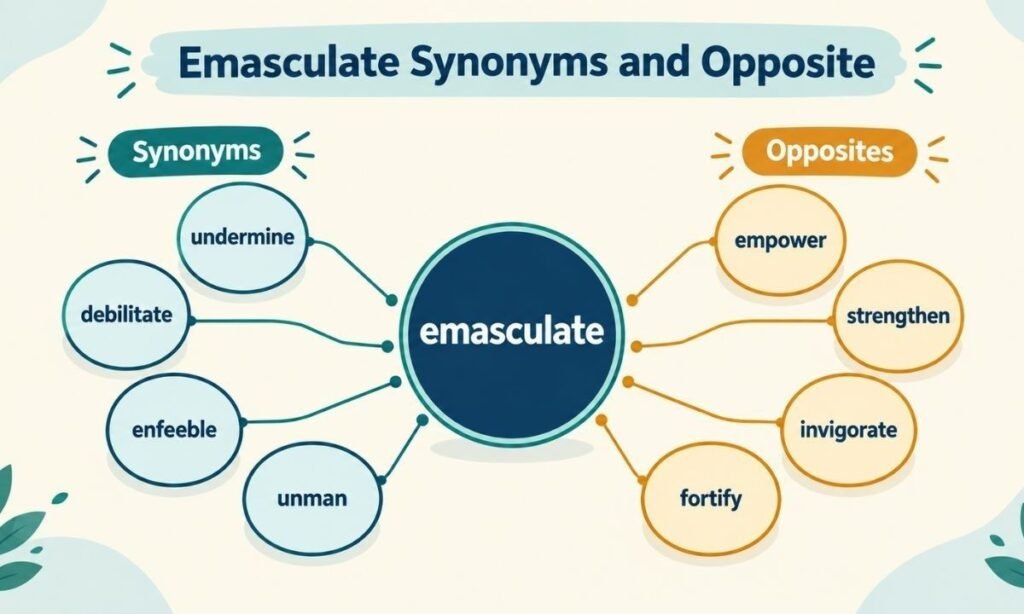
Emasculate Synonyms
The best synonym depends on the sense you intend. These come from the dictionaries and thesauruses reviewed:
- To weaken: Dictionary.com lists soften, devitalize, undermine, and debilitate.
- Other listed synonyms: Wiktionary lists unman, debilitate, enervate, and enfeeble.
- Literal sense: WordWeb lists castrate, along with demasculinize and the rare evirate.
- Adjective sense: WordWeb lists effeminate and epicene for the adjective. These can sound dated or offensive in modern writing.
Opposite of Emasculate
The sources reviewed do not list a single formal antonym for emasculate. These are editorial suggestions that fit the main senses:
- Opposite of weakening: empower, strengthen, invigorate, fortify, bolster
- Opposite of removing masculinity: masculinize, which is more technical
What Does Demasculate Mean?
Demasculate has no widely accepted meaning of its own. When people write it, they almost always intend to emasculate.
Is Demasculate a Word?
It is not a standard English word. Freelance Writing Jobs calls it a misspelling and says it is not an English word.
The full picture is a little more nuanced. Wiktionary lists demasculate among the synonyms of emasculate. That shows the form appears in real use, but it does not make it standard. The safest description is rare and nonstandard.
Demasculate Pronunciation
No major dictionary in the sources reviewed gives a standard pronunciation for demasculate. Speakers who use it tend to say dee-MASS-kyuh-layt by analogy with the real word. Because it is nonstandard, this guide does not recommend the form in speech or writing.
Why Do People Use Demasculate?
The most likely reason is the familiar de- pattern. Many words that reverse a base word begin with de-, such as deconstruct and demote. Since emasculate means to take masculinity or strength away, de- seems like a natural fit.
Demasculinize may also play a part. It is a real word and it sits close to emasculate in meaning, so demasculate can look like a shortened version of it. That second explanation is a reasonable inference rather than a documented finding.
Demasculate vs Demasculinize
If you want a de- word, demasculinize is the safer choice. WordWeb lists demasculinize and the British spelling demasculinise as synonyms for the castration sense of emasculate.
In American English, write demasculinize. In British English, demasculinise is the usual spelling. The word often appears in scientific or social writing to mean reducing masculine traits. Emasculate is more common in everyday prose and carries a stronger emotional charge.
The Key Difference Between Emasculate and Demasculate
The difference comes down to acceptance and origin, not meaning.
Standard vs Non-Standard: The Core Issue
Emasculate is documented in dictionaries and understood everywhere. Demasculate is not. Readers will usually guess your intent, but the nonstandard form can distract them or look like a typo. Editors and teachers will almost always correct it to emasculate.
Why Is It Emasculate and Not Demasculate?

The answer lies in the word’s history. Wiktionary traces emasculate to Medieval Latin, built from ē(x)-, meaning “out” or “from,” plus masculus, meaning “male.”
So the opening e- is not a negative prefix like de-. It carries the idea of removing something out of a person or thing. English borrowed the word already formed, which is why it begins with e-.
A simple memory trick: emasculate means to take the male qualities out. The e- stands for “out.”
When to Use Emasculate vs Demasculate

When to Use Emasculate
Choose emasculate whenever you want a standard, recognized word. It fits these situations:
- Describing a law, rule, or plan that has lost its force
- Describing someone who feels stripped of masculinity or authority
- Referring to castration in veterinary, historical, or technical contexts
- Referring to flower preparation in plant breeding
Why You Should Avoid Demasculate
Skip demasculate in school, work, publishing, and any writing judged for accuracy. It adds no meaning that emasculate does not already provide, and it can look like a mistake. If you need a de- form for a technical, descriptive purpose, use demasculinize and make sure your audience will understand it.
Common Mistakes to Avoid
- Writing “demasculate.” Incorrect: The ruling will demasculate the agency. Correct: The ruling will emasculate the agency. Demasculate is nonstandard.
- Assuming every “removing” word needs de-. Incorrect: I assumed it must be demasculate, like demote. Correct: Emasculate takes its e- from Latin, meaning “out.” The de- pattern does not apply here.
- Treating demasculinize as a perfect substitute. Incorrect: The amendment demasculinized the bill. Better: The amendment emasculated the bill. In the sources reviewed, demasculinize is mainly tied to castration or reducing masculine traits. It is not listed with the sense of weakening a law, so emasculate is the clearer choice there.
- Using emasculate only for people. Incorrect: Thinking the word cannot describe a policy or institution. Correct: The new rules emasculated the committee. Dictionaries include the sense of depriving something of strength.
Frequently Asked Questions
Is demasculate a real word?
Not in standard English. It appears as a rare variant in some sources, but it is generally treated as a misspelling of emasculate. Use emasculate in formal writing.
Can emasculate describe things other than people?
Yes. It can describe laws, rules, teams, or ideas that lose their power. For example, “The court emasculated the regulation” uses the word without any gender meaning.
How do you pronounce emasculate?
In American English, say ih-MASS-kyuh-layt for the verb, with the stress on the second syllable. The adjective may end in a softer “-lut.”
What is the opposite of emasculate?
No single formal antonym is listed in the sources reviewed. Empower, strengthen, and invigorate work for the sense of weakening. Masculinize is a more technical option for removing masculinity.
Is demasculinize the same as emasculate?
They overlap but are not identical. Demasculinize is a real word, often used in technical contexts, that usually means to reduce masculine traits. Emasculate is more common and often means to weaken or humiliate.
Is emasculate offensive to use?
It can be. The word is often tied to stereotypes about what makes a man masculine. Use it with care, or choose a neutral verb such as weaken or undermine when gender is not the point.
Is emasculate an adjective as well as a verb?
Yes. As an adjective, it can mean weak or lacking vigor, as in “an emasculate argument.” The adjective is less common than the verb and can sound formal or dated.
Conclusion
Emasculate is the standard word, and demasculate is a nonstandard variant that readers will usually treat as a mistake. When you want a de- form with real dictionary support, choose demasculinize and use it for its narrower, more technical meaning. Everywhere else, write emasculate.