“Modeling” is the standard American English spelling, and “modelling” is the standard British English spelling. Both words come from the verb “model,” and both are correct in their own regions. The meaning is identical whether you are discussing fashion, mathematics, or 3D design.
The difference comes down to one letter. American English uses a single L before the -ing ending, while British English doubles it. Consistency also matters for credibility in professional writing. This guide explains the spelling rule, shows how each form works in real sentences, and helps you choose the right one for your audience.
Modeling vs. Modelling: Key Differences
The two spellings are regional variants of the same word. Neither is a mistake, and neither changes the meaning, pronunciation, or grammar.
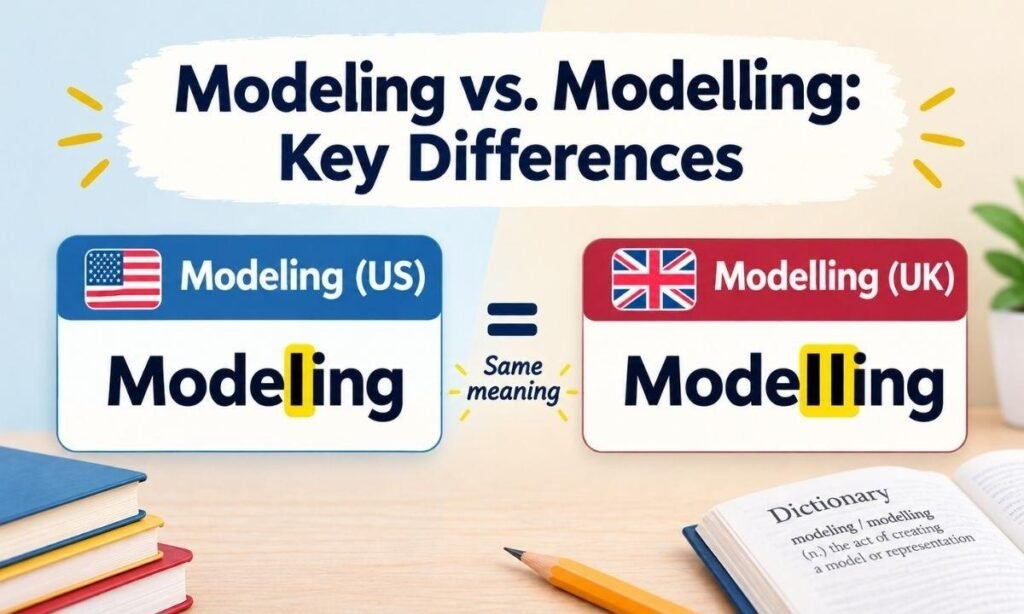
| Feature | Modeling | Modelling |
| Standard in | American English | British English |
| Also used in | Canada (often) | UK, Australia, New Zealand, Ireland, South Africa, India |
| Verb forms | model, models, modeled, modeling | model, models, modelled, modelling |
| Meaning | Identical | Identical |
| Example | She is modeling the new jacket. | She is modelling the new jacket. |
If you write for an American audience, use “modeling.” If you write for a British or Commonwealth audience, use “modelling.” Pick one and apply it throughout a document.
Same Sentence, Two Spellings, Zero Difference in Meaning
Compare these pairs:
- American: The team is modeling customer behavior to predict sales.
- British: The team is modelling customer behaviour to predict sales.
A reader in any country understands both sentences the same way. Only the spelling convention signals the regional variety. Notice that “behavior” and “behaviour” follow the same kind of regional split.
Regional Spelling: Who Uses Which
Use the spelling that matches your readers and the style guide you follow.

- United States: “Modeling” is the standard spelling. American dictionaries list it as the main form.
- United Kingdom: “Modelling” is standard in newspapers, universities, and publishers.
- Canada: Canadian usage mixes American and British conventions. Both spellings appear, and “modeling” is common, but follow your organization’s style guide.
- Australia, New Zealand, Ireland, India, South Africa: These varieties generally follow British spelling, so “modelling” is typical.
International companies often choose one spelling for all English content. Whichever you choose, do not mix both forms in the same piece.
What Does “Modeling” Mean in American English?
In American English, “modeling” is the present participle of the verb “model” and also a noun. It appears in several common contexts:
- Fashion and photography: Wearing clothing or posing for artists and photographers. She started modeling in college.
- Representing something: Creating a simplified version of a system, object, or process. The engineers are modeling airflow around the wing.
- Demonstrating behavior: Showing others how to do something by example. Teachers are modeling good reading habits for students.
- Shaping material: Forming clay, wax, or similar substances. He enjoys modeling clay figures.
As a noun, “modeling” names the activity or field: Financial modeling requires strong spreadsheet skills.
What Does “Modelling” Mean in British English?
“Modelling” carries exactly the same meanings as “modeling.” The only difference is the doubled L, which follows British spelling conventions.
- She has been modelling for ten years. (fashion)
- Climate modelling helps scientists test different scenarios. (representing a system)
- Good managers practise modelling the behaviour they expect. (demonstrating)
British writing also uses “modelled” for the past tense: The firm modelled three possible outcomes.
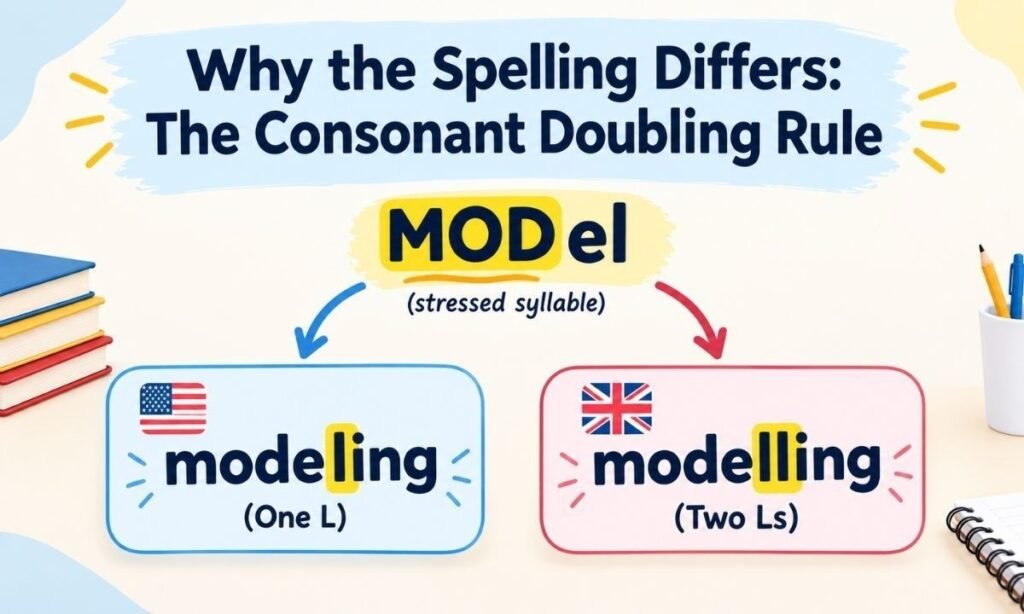
Why the Spelling Differs: The Consonant Doubling Rule
The Rule Explained
The spelling split comes from different rules about doubling a final consonant before a suffix such as -ing or -ed.
- British English doubles a final L after a single vowel, even when the last syllable is unstressed. That is why “model” becomes “modelling” and “modelled.”
- American English generally doubles the final consonant only when the stress falls on the last syllable. In “model,” the stress is on the first syllable (MOD-el), so American English keeps a single L: “modeling” and “modeled.”
Compare this with a verb stressed on the final syllable, like “compel.” Both varieties write “compelling” and “compelled,” because the stress is on the last syllable.
This is a spelling convention, not a universal law of English. Some words follow other patterns, so check a dictionary when you are unsure.
Related Word Forms Follow the Same Pattern
The same rule applies to many verbs ending in a single L after a vowel in an unstressed syllable.
| Base verb | American spelling | British spelling |
| model | modeling, modeled | modelling, modelled |
| travel | traveling, traveled | travelling, travelled |
| cancel | canceling, canceled | cancelling, cancelled |
| label | labeling, labeled | labelling, labelled |
| level | leveling, leveled | levelling, levelled |
The noun “modeler” (American) and “modeller” (British) follow the same split. Note that American dictionaries sometimes list a doubled form such as “cancelled” as an accepted variant, but the single-L form is more common in the United States.
Modeling or Modelling in Specific Fields
Searchers often ask about the spelling in a particular field. The rule does not change by topic. Only the regional convention matters.
Mathematical Modeling
In American texts, you will see “mathematical modeling.” In British texts, “mathematical modelling.” Both describe building equations or simulations to represent real-world systems. Academic journals follow their own house style, so check the author guidelines before submitting.
3D Modeling
“3D modeling” is the dominant spelling in American software documentation, game development, and design tools. “3D modelling” is common in UK and Australian publications. Software interfaces often use the American form, but a British article about the same software may still use “modelling.”
Fashion Modeling
The fashion industry is international, so both spellings appear. An American agency writes “modeling career,” while a London agency writes “modelling career.” The noun “model” is spelled the same everywhere, so only the -ing form changes.
Modelling or Modeling in Grammar
Grammatically, both spellings can function in two ways:
- Present participle: She is modeling the dress.
- Gerund (verb used as a noun): Modeling is a competitive career.
The word can also serve as a plain noun, as in scientific modeling. The grammatical function is the same in both spellings.
What Dictionaries Say
Major American dictionaries, such as Merriam-Webster, list “modeling” as the main spelling and note “modelling” as the chiefly British variant. British dictionaries, such as the Oxford and Cambridge dictionaries, show “modelling” as the standard British form and mark “modeling” as the American spelling. If you need a ruling for a particular publication, check the dictionary named in its style guide.
Common Mistakes
- Mixing spellings in one document.
- Incorrect: The modeling process was modelled on earlier work.
- Correct: The modeling process was modeled on earlier work. (American)
- Choose one convention and keep it throughout.
- Using “modelling” for an American audience.
- Incorrect for US readers: He is modelling for a magazine.
- Correct for US readers: He is modeling for a magazine.
- Writing “modeling” for a British audience.
- Incorrect for UK readers: The firm is modeling future demand.
- Correct for UK readers: The firm is modelling future demand.
- Treating the other spelling as an error. Neither form is wrong. Each is correct in its own variety.
- Misspelling the root. “Modelling” has two Ls and “modeling” has one. Forms such as “modelng” or “moddeling” are errors in every variety.
Frequently Asked Questions
Is it modeling or modelling?
Both are correct. “Modeling” is the American spelling, and “modelling” is the British spelling. Choose the one that matches your audience.
Which spelling should I use in American English?
Use “modeling” with one L. Use “modeled” and “modeler” as well. Writing “modelling” in an American context may look like a British spelling to readers.
Is “modelling” ever correct in the United States?
It is not standard, but it is understood. Some American writers use it, especially those influenced by British English, and some company names or titles may keep it. For general American writing, use “modeling.”
Does the meaning change between modeling and modelling?
No. The meaning is the same in fashion, science, art, and technology. Only the spelling convention differs.
Why does British English double the L?
British spelling doubles a final L after a single vowel when adding a suffix like -ing or -ed, even in unstressed syllables. American spelling generally doubles only after a stressed syllable. This is a convention that developed differently in each variety.
Which spelling is used in Canada and Australia?
Australia generally follows British spelling, so “modelling” is typical there. Canadian usage is mixed, and “modeling” is common, so follow the style guide of your publication or employer.
Are “modeled” and “modelled” both correct?
Yes. “Modeled” is the American past tense, and “modelled” is the British past tense. The same pattern applies to “modeler” and “modeller.”
Conclusion
“Modeling” and “modelling” are two accepted spellings of the same word. American English uses one L, while British English doubles it. The meaning never changes, so the right choice depends on your readers and your style guide. Pick the spelling that fits your audience, and keep it consistent from the first sentence to the last.