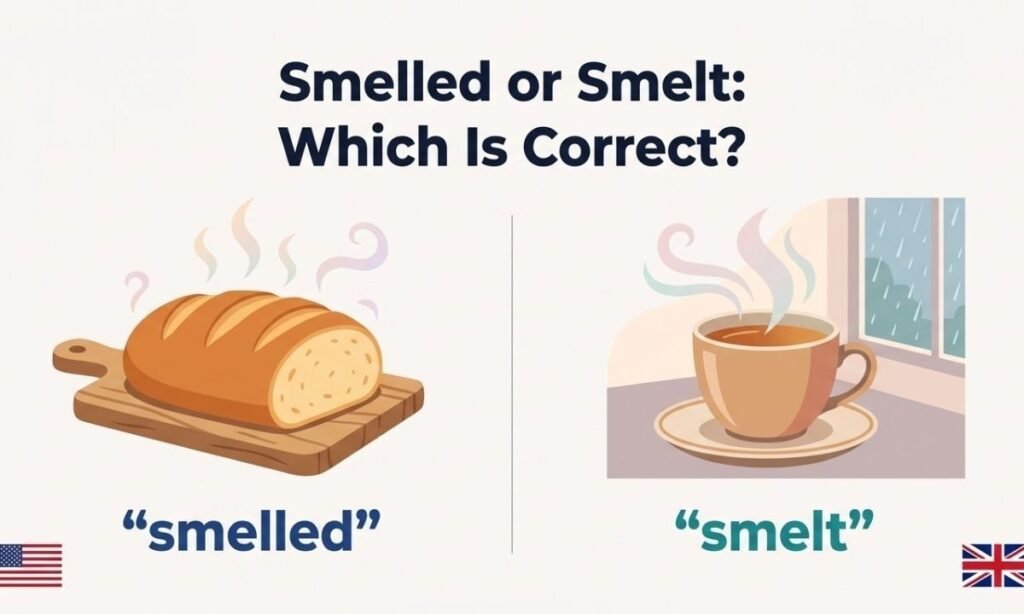
Both smelled and smelt are correct past tense forms of the verb smell. Smelled is the standard choice in American English, while smelt is more common in British English. The two forms mean the same thing when they describe scent, so neither is a mistake.
The confusion exists because smelt has other meanings. It can also mean to extract metal from ore, and it is named after a small fish. This guide explains when to use each form, how dictionaries treat them, and how to choose the right one for your audience. Getting it right matters most in formal writing, where consistent spelling signals care.
What Does “Smelled” Mean?
Smelled is the past tense and past participle of the regular verb smell. Like most English verbs, it forms its past with the -ed ending. It has two main uses:
- To detect a scent with the nose: I smelled smoke when I opened the door.
- To give off a particular scent: The bakery smelled like cinnamon and warm bread.
It also appears in figurative expressions, such as sensing that something is wrong. She smelled a trap the moment he offered the deal.
As a past participle, smelled follows have, has, or had. The hallway has smelled of paint all week.
“Smelled” in Different American English Contexts
In American English, smelled is the default in nearly every setting. You can use it without hesitation in all of the following.
- Everyday speech and messages: Something smelled burnt, so I checked the oven.
- Fiction and storytelling: The cabin smelled of pine and old books.
- News and journalism: Residents said the air smelled of gas before the evacuation.
- Business and academic writing: Participants reported that the samples smelled faintly of citrus.
American readers rarely see smelt used for scent. When they do, it often reads as British or slightly old-fashioned. Choosing smelled keeps your writing natural for a U.S. audience.
What Does “Smelt” Mean?
Smelt has three separate meanings, and only one of them is about scent.
1. Past tense of “smell.” This is the smelt that competes with smelled. It is a variant past form, used mainly in British English. The room smelt of lavender.
2. A verb meaning to extract metal. To smelt is to heat ore until the metal separates from it. This verb is regular, so its past tense is smelted. Workers smelted the iron ore in large furnaces.
3. A noun for a small fish. A smelt is a small, silvery fish. The plural can be smelt or smelts. We fried a basket of fresh smelt.
These meanings share a spelling, but they are different words in practice. Context almost always makes clear which one is meant.
All Three Meanings of “Smelt” at a Glance

| Meaning | Part of speech | Forms | Example sentence |
| Past of smell | Verb (variant of smelled) | smell, smelt, smelt | The garden smelt of roses after the rain. |
| To extract metal from ore | Verb | smelt, smelted, smelted | The company smelted copper at the plant. |
| A small fish | Noun | smelt, smelts | The smelt run begins in early spring. |
Smelled vs. Smelt: Key Differences That Actually Matter
For the scent meaning, the difference is about region and convention, not correctness. Here is what matters in practice.
- Meaning: For scent, smelled and smelt are interchangeable.
- Region: Smelled is the standard form in American English. Smelt is used in British English, alongside smelled.
- Grammar: Both work as the past tense and the past participle.
- Risk of confusion: Smelt can be mistaken for the metal verb or the fish. Smelled has no competing meaning.
- Consistency: Pick one form for a given piece of writing and stay with it.
If you write for a U.S. audience, use smelled. If you write for a British or Commonwealth audience, either form is acceptable, though smelt will feel more familiar to many readers.
Regional Spelling: Smelled vs Smelt (Past Tense)
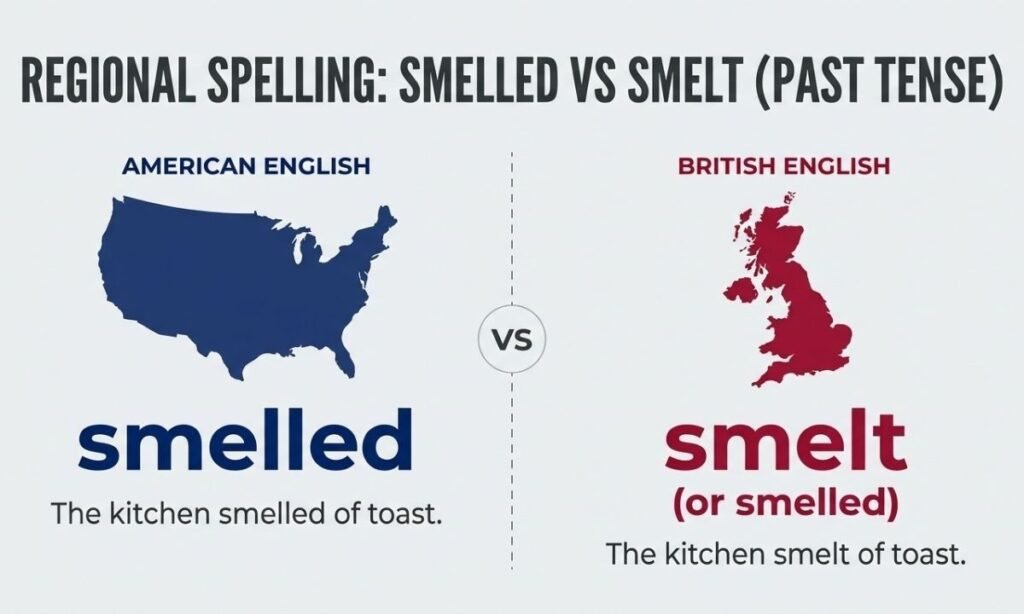
American English strongly prefers the -ed ending for this verb. British English accepts both smelled and smelt, and many British writers choose smelt. Neither form is wrong in either country, but one will look more natural depending on where your readers live.
British writers also use smelled freely, and many do so in modern writing. So smelt is not required in British English. It is simply an available and familiar option.
The “-t” Verb Pattern: Where “Smelt” Belongs
Smelt belongs to a group of English verbs that can form the past tense with -t or -ed. Many British writers use the -t forms. American English generally prefers -ed.
| Base verb | American usage | British usage (common) |
| smell | smelled | smelt or smelled |
| spell | spelled | spelt or spelled |
| burn | burned | burnt or burned |
| learn | learned | learnt or learned |
| dream | dreamed | dreamt or dreamed |
| spill | spilled | spilt or spilled |
Seeing smelt as part of this pattern explains why it exists. It is not an error or a separate rule. It is one of several -t variants that British English keeps in everyday use.
Smelled or Smelt Oxford Dictionary
Major dictionaries record both forms as past tense and past participle of smell. Oxford dictionaries, which reflect British usage, list smelt alongside smelled. American dictionaries, such as Merriam-Webster, treat smelled as the main form and present smelt as a variant, often marked as chiefly British.
This matches what writers actually do. The dictionaries agree that both forms are standard. They differ mainly in which form they present first. If you need to confirm a detail, check the entry for smell in the dictionary your publication follows.
Smelled Good or Smelt Good
Both phrases are correct, and the choice follows the same regional pattern. American English uses smelled good. British English can use smelled good or smelt good.
- American: The soup smelled good from the street.
- British: The soup smelt good from the street.
In these sentences, smell works as a linking verb. A linking verb connects the subject to a description, so it takes an adjective, not an adverb. That is why good is correct here.
Be careful with well. The dog smelled well suggests the dog has a strong sense of smell. It does not describe the odor of the dog. The same logic applies to bad and badly. The garbage smelled bad describes the odor, while smelled badly is usually read as a weak sense of smell.
Smelled or Smelt Synonym
If you want to avoid the choice altogether, a different verb can work. The right synonym depends on which meaning you intend.
When the subject detects a scent:
- sniffed
- detected
- noticed
- caught a whiff of
- scented
When the subject gives off an odor:
- reeked (strong and unpleasant)
- stank (strong and unpleasant)
- gave off an aroma (pleasant)
- carried the scent of
When you mean the metal process:
- extracted
- refined
- processed
Note that refined and extracted are broader than smelted. Use smelted when you mean heating ore specifically.
Side-by-Side Examples: Smelled vs. Smelt in Real Sentences
“Smelled” in American English Writing
- When I walked into the garage, it smelled like fresh paint.
- My neighbor said she smelled smoke around midnight.
- The lobby had smelled of coffee since early morning.
- The milk smelled sour, so I threw it out.
“Smelt” in British English Writing: Past Tense of Smell
- The kitchen smelt of toast and marmalade.
- She smelt rain in the air and went to fetch her coat.
- The old library had always smelt of dust and leather.
Same Sentence, Two Spellings: Clean Meaning vs. Potential Ambiguity
Some sentences are clear with smelled but unclear with smelt. Consider this one.
- The workers smelt copper at the plant.
A reader could take this as the present tense of the metal verb, meaning the workers extract copper. A reader could also take it as the past tense of smell, meaning they detected copper. Using smelled removes the doubt.
| Sentence | Meaning |
| The workers smelled the copper. | They detected its scent. |
| The workers smelted the copper. | They extracted it from ore. |
When any ambiguity is possible, choose the form that cannot be misread.
Common Mistakes Writers Make with “Smelled” and “Smelt”
Mistake 1: Using smelt as the past tense of the metal verb.
- Incorrect: The factory smelt iron last year.
- Correct: The factory smelted iron last year.
- The metal verb is regular, so its past tense is smelted.
Mistake 2: Calling smelt a spelling error.
- Incorrect claim: “Smelt” is never correct for scent.
- Correct: “Smelt” is a valid past form of smell, mainly in British English.
- It is a standard variant, not a mistake.
Mistake 3: Mixing forms in one document.
- Inconsistent: The room smelled of smoke, and the hall smelt of gas.
- Consistent: The room smelled of smoke, and the hall smelled of gas.
- Pick one form and keep it throughout.
Mistake 4: Using well or badly to describe an odor.
- Incorrect: The soup smelled well.
- Correct: The soup smelled good.
- Use an adjective after smell when describing an odor.
Mistake 5: Writing smelled when you mean the fish.
- Incorrect: We caught a bucket of smelled.
- Correct: We caught a bucket of smelt.
- The fish is always a noun spelled smelt.
Frequently Asked Questions
Is smelt the past tense of smell?
Yes. Smelt is an accepted past tense and past participle of smell. It is used mainly in British English. Smelled is also correct everywhere and is the standard form in American English.
Is smelled or smelt more common in American English?
Smelled is the standard in American English. Smelt is understood but is seen as a British variant, so most U.S. writers use smelled.
Can I use smelt in American English?
You can, and readers will understand it. However, it may look unusual or overly British to a U.S. audience. For American publications, smelled is the safer choice.
What is the past participle of smell?
The past participle is smelled or smelt. Use whichever form matches your regional style. The hallway has smelled of paint all week. The hallway has smelt of paint all week.
What does smelt mean besides the past tense of smell?
Smelt also means to extract metal from ore by heating it, and it names a small silvery fish. These are separate words that share a spelling with the past form of smell.
What is the past tense of smelt when it means to extract metal?
It is smelted. The metal verb is regular, so its past tense and past participle are both smelted. The foundry smelted the ore into bars.
Should I use smelled or smelt in formal writing?
Follow the style of your audience. Use smelled for American publications. For British publications, either form is acceptable, so follow the house style or choose one and stay consistent.
Conclusion
Smelled and smelt are both correct past forms of smell, and they mean the same thing when they describe scent. Use smelled for American audiences, and treat smelt as an acceptable British variant.
Remember that smelt also means to extract metal and names a fish, so choose smelled whenever clarity matters. Whichever form you use, keep it consistent throughout your writing.