The correct spelling is separate. “Seperate” is a common misspelling and is not an accepted variant in American or British English. The confusion comes from the middle of the word, where many writers hear an “e” sound and type it instead of an “a.” That one small slip makes it one of the most commonly misspelled words in English.
Separate works as a verb, an adjective, and, in the plural, a noun. Knowing how each form is built and pronounced makes the spelling easier to remember. This guide explains the meanings, shows example sentences, and gives you a memory trick and a list of common mistakes to avoid.
What Does Separate Mean?
Separate has one core idea: things that are apart, divided, or distinct from one another. The word traces back to the Latin separare, meaning “to set apart.” Its meaning and pronunciation change slightly depending on whether it is used as a verb or an adjective.
Separate as a Verb
As a verb, separate means to divide something into parts, to keep two things apart, or to move away from each other. It can take an object (transitive) or stand alone (intransitive).
- Transitive: “Please separate the recyclables from the trash.”
- Intransitive: “The two groups separated at the fork in the trail.”
The verb is pronounced with a clear long “a” at the end: SEP-uh-rayt.
Separate as an Adjective
As an adjective, separate means distinct, individual, or not connected to something else. It describes nouns and usually appears before them.
- “We booked separate rooms for the trip.”
- “That is a separate issue from the budget.”
The adjective is pronounced differently from the verb. The ending is weaker, so it sounds closer to SEP-rit or SEP-uh-rit.
Common Verb Uses of “Separate”

The verb appears in many everyday situations. These are the patterns you will meet most often:
- Dividing a mixture or group: “Separate the egg whites from the yolks.”
- Sorting into categories: “The teacher separated the students into three teams.”
- Keeping things apart: “A narrow river separates the two towns.”
- Ending a relationship or living arrangement: “They separated last spring but have not filed for divorce.”
- Distinguishing between ideas: “It is hard to separate fact from opinion in that report.”
- Leaving a job or military service (formal, especially American usage): “She separated from the Navy after eight years.”
The verb is often followed by from, into, or out:
- separate from: “Separate the whites from the yolks.”
- separate into: “Separate the class into pairs.”
- separate out: “Separate out the damaged items before shipping.”
Common Adjective Uses of “Separate”
As an adjective, separate stresses that something is its own item, not shared or combined.
- Individual items: “Each guest received a separate invoice.”
- Distinct topics: “Customer service and billing are separate departments.”
- Independent paths: “After college, they went their separate ways.”
- Different things entirely: “Owning a car and knowing how to drive are two separate matters.”
Separate is also the first half of useful fixed phrases, such as separate checks, separate bedrooms, and a separate entrance.
Related Word Forms: Separate
Every related form keeps the same “-a-” in the middle. If you spell the base word correctly, the rest follow naturally.
| Correct form | Part of speech | Example sentence | Common misspelling |
| separate | verb, adjective | “Keep the receipts separate.” | seperate |
| separated | verb (past), adjective | “The separated pieces were labeled.” | seperated |
| separating | verb (-ing form) | “She is separating laundry by color.” | seperating |
| separately | adverb | “Pay for each item separately.” | seperately |
| separation | noun | “The separation lasted two years.” | seperation |
| separator | noun | “Use a separator between the sections.” | seperator |
| separable | adjective | “The two issues are not easily separable.” | seperable |
| inseparable | adjective | “The twins were inseparable.” | inseperable |
| separates | noun (plural) | “She bought separates she could mix and match.” | seperates |
The noun separates refers to clothing items, such as skirts, tops, or pants, that are sold individually and can be combined in different outfits.
What Is “Seperate”?
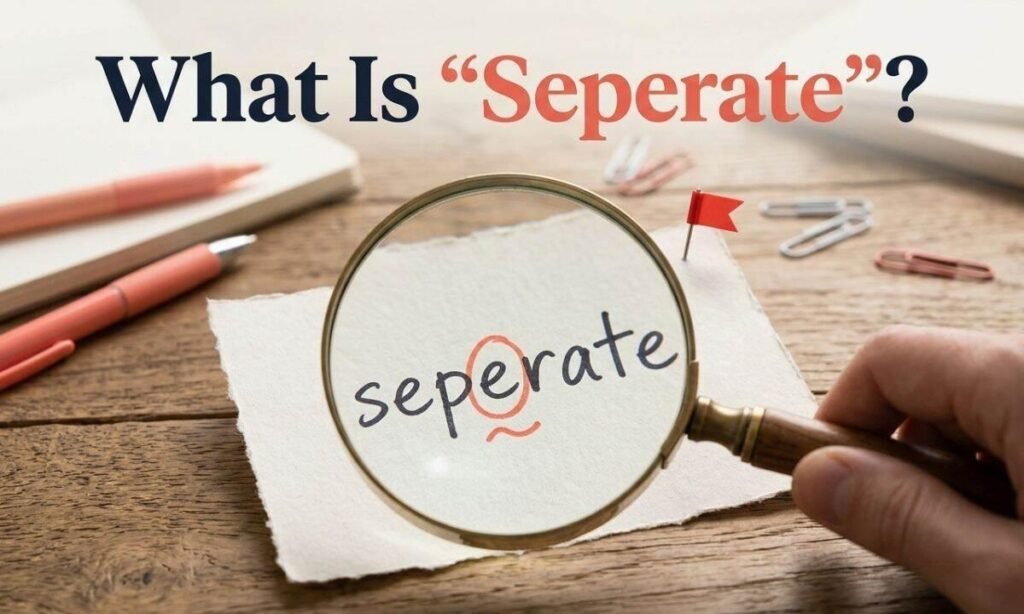
“Seperate” is a misspelling of separate. It does not appear as a headword in standard dictionaries, and spell checkers flag it. It is not a regional spelling, an older form, or an acceptable alternative.
Writers make this error for a simple reason. In everyday speech, the second syllable of separate is unstressed and often reduced to a quick, vague sound. That sound gives no clue about which vowel letter belongs there, so many people guess “e.”
| Spelling | Status | Where it is used | Example |
| separate | Correct | American, British, Canadian, and Australian English | “Let’s use separate folders.” |
| seperate | Incorrect | Not accepted in any standard variety | “Let’s use seperate folders.” (wrong) |
Because “seperate” is not a variant but an error, no style guide treats it as acceptable in formal or informal writing. Use it only when you are discussing the misspelling itself.
Separate vs Seperate UK Spelling
Separate is spelled the same way in British and American English. Unlike color and colour or organize and organise, this word has no regional alternative.
“Seperate” is also wrong in the UK, Canada, Australia, and elsewhere. If you see it in British writing, it is a typo, not a local convention. You can safely use “separate” for any audience.
Seperate or Separate Pronunciation
The verb and the adjective have different endings, but the first two syllables sound alike in both.
| Form | Approximate pronunciation | Ending sound |
| Verb | SEP-uh-rayt | Clear long “a” (like rate) |
| Adjective | SEP-rit or SEP-uh-rit | Reduced, like it |
Both forms stress the first syllable. The middle syllable is weak in both, which is exactly why spelling errors happen. Your ear hears “sep-ur-ate,” but your eyes need to remember “sep-A-rate.”
The Memory Trick That Works Every Time
The most reliable trick uses a short phrase: there is a rat in separate.
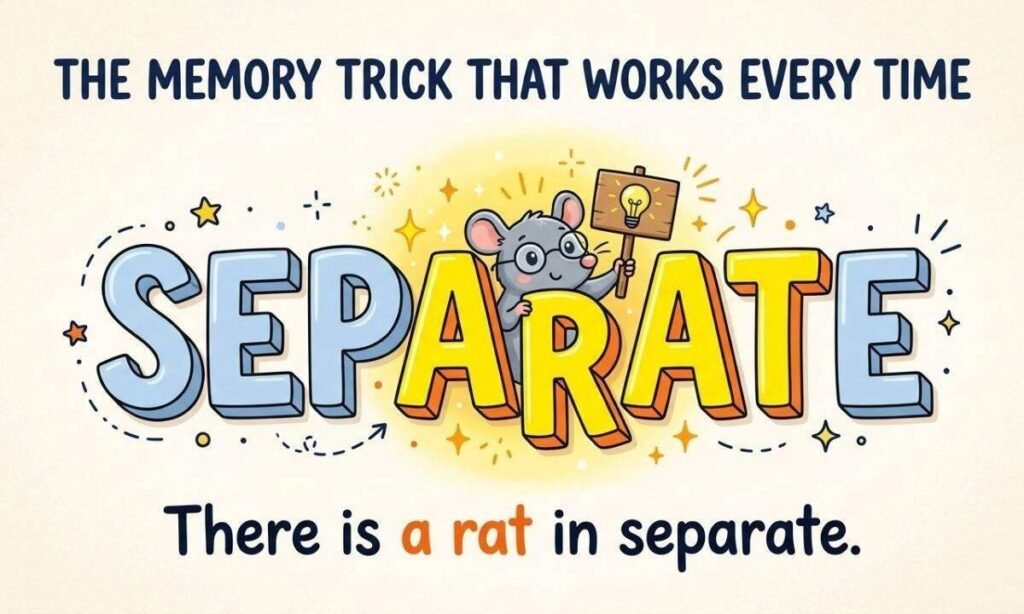
Look at the middle of the word: sepARATe. The letters “a-r-a-t” hide the word “rat,” and the word “a rat” starts with the vowel you need.
Here is how to use it:
- Write the first three letters: s-e-p.
- Add a-r-a-t, picturing a rat in the middle of the word.
- Finish with e.
A second option is to remember that separate does not follow the sound of its middle syllable. When you are unsure, say it slowly as “sep-A-rate,” and stress the “a” in your head.
Common Mistakes to Avoid
Most errors come from the same root problem: replacing the middle “a” with “e.” Watch for these patterns.
- Seperate instead of separate
- Incorrect: “The two files are seperate.”
- Correct: “The two files are separate.”
- Why: The middle vowel is “a,” not “e.”
- Seperately instead of separately
- Incorrect: “Please file them seperately.”
- Correct: “Please file them separately.”
- Why: The adverb keeps the base spelling and adds -ly.
- Seperation instead of separation
- Incorrect: “The seperation of church and state is a core principle.”
- Correct: “The separation of church and state is a core principle.”
- Why: Derived nouns keep the “a.”
- Using the adjective as an adverb
- Nonstandard: “We traveled separate.”
- Better: “We traveled separately.” or “We traveled apart.”
- Why: Adverbs that describe how an action happens usually need -ly.
- Mixing up the verb and adjective pronunciation
- Saying “sep-rit” for the verb in careful speech can sound unclear. Use the full “-rayt” ending for the verb.
Frequently Asked Questions
Is it separate or seperate?
The correct spelling is separate. “Seperate” is a frequent misspelling, and no major style guide accepts it as a valid variant.
Is “seperate” a real word?
No. It is not recognized as a word in standard dictionaries, and most spell checkers will mark it as an error. It appears often because many people spell the word the way they hear it.
Is “seperate” a British spelling?
No. British English uses the same spelling as American English: separate. “Seperate” is incorrect everywhere.
How do you pronounce separate?
The verb is pronounced SEP-uh-rayt, with a full “ayt” ending. The adjective is usually pronounced SEP-rit or SEP-uh-rit, with a weaker ending. Both stress the first syllable.
Why do people misspell separate?
The middle syllable is unstressed and sounds like a vague, short vowel. Because the sound does not reveal the correct letter, writers often guess “e” instead of “a.”
What is an easy way to remember how to spell separate?
Remember that there is “a rat” in separate: separate. Picturing the rat in the middle of the word helps you recall the “a.”
Can separate be a noun?
Yes, but only in a specific sense. In the plural, separates refers to individual clothing pieces, such as skirts or tops, that can be worn in different combinations. Outside of fashion, the word is usually a verb or adjective.
Conclusion
Separate is the only correct spelling in American, British, and every other standard form of English. Seperate is simply a spelling error caused by the weak sound in the middle syllable.
Keep the “a” in the middle of every related form, including separated, separately, and separation. When in doubt, use the memory trick: there is a rat in separate.