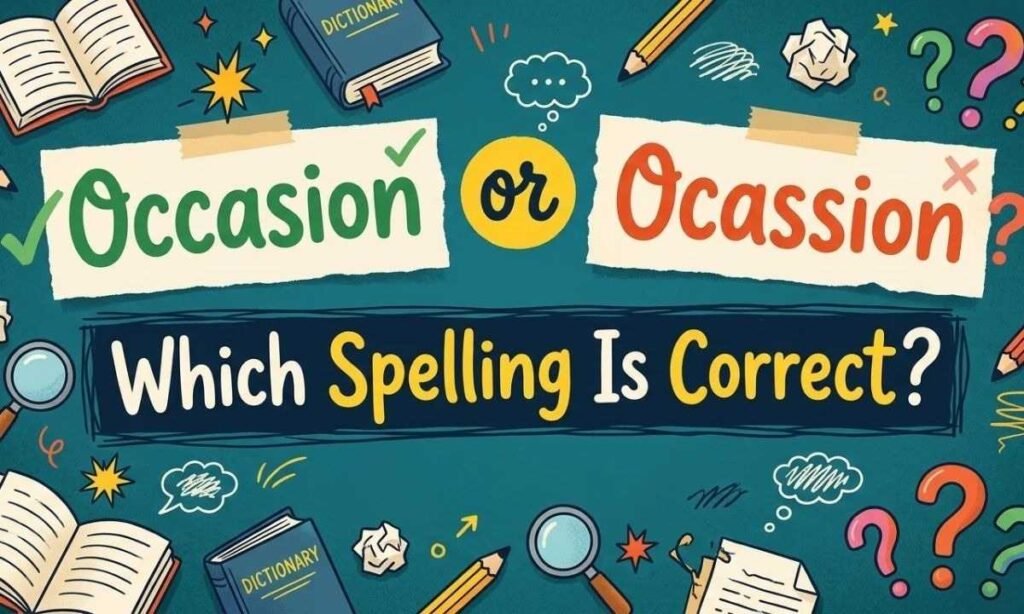
Occasion is the correct spelling. Ocassion is a common misspelling and is not an English word. The noun occasion means a particular time, a special event, or a suitable opportunity, and it is spelled with two c’s and one s.
Getting this right matters in invitations, emails, school work, and formal documents, where a spelling error is easy to spot. This guide covers the meaning, pronunciation, plural, synonyms, and verb use of occasion. It also explains why ocassion looks tempting, shows examples, and ends with a short quiz. Short rules and a simple decision guide help you spell it correctly every time.
Comparison Overview (Occasion or Ocassion)
The table shows the difference at a glance.
| Spelling | Status | Meaning | Example |
| Occasion | Correct | A time, event, or opportunity | The wedding was a joyful occasion. |
| Ocassion | Incorrect | None, it is a misspelling | Not used in standard English |
If you remember one thing, remember this: two c’s, one s.
Definition of Occasion
Meaning
Occasion is mainly a noun with several related senses. One sense is a particular point at which an event takes place. Another is a favorable combination of circumstances, time, and place, meaning an opportunity. A third sense is a special event or celebration, such as a birthday or graduation.
It can also be a verb, covered in a later section. Merriam-Webster records the first known use of the noun in the 14th century, so the word has a long history in English.
Examples
- The anniversary was a happy occasion for the whole family.
- She had no occasion to call him last week.
- Please save this jacket for a formal occasion.
Definition of Ocassion
Meaning
Ocassion has no meaning because it is not a word. It appears when writers move the double letter from c to s, usually because they are typing quickly or relying on how the word sounds.
Examples
These are wrong spellings with the correct forms beside them:
- Incorrect: We celebrated the ocassion with cake.
Correct: We celebrated the occasion with cake. - Incorrect: It was a special ocassion for her.
Correct: It was a special occasion for her.
Main Differences Between Occasion and Ocassion
The difference is not one of meaning or grammar. It is simply correct spelling versus incorrect spelling. Occasion is accepted in both American and British English, while ocassion is a misspelling in every variety.
Common Contexts Where Occasion Is Used
Special Events
Occasion often names a notable event, such as a wedding, a graduation, or a festival. Phrases like “a formal occasion” and “a festive occasion” are common.
Particular Times
It can also mean a specific moment. In the sentence “On that occasion, he arrived late,” the word points to one time, not a general habit.
Reasons or Opportunities
Occasion can mean a chance to do something or a reason for it. “She took the occasion to thank her team” uses it as an opportunity. “His comment was the occasion of an argument” uses it as a trigger.
Spelling Pattern Breakdown
Break the word into syllables to see the pattern: oc·ca·sion. The first syllable ends with one c, and the second begins with another, which creates the double c. The letter s appears only once.
Many people mix this up because the middle sound is a soft “zh” (the same sound as in “vision”). The spelling does not match the pronunciation closely, so the double letter is easy to misplace.
A simple memory aid: two c’s, one s. You can also remember that the word has two c’s like the two c’s in “success,” the word most people spell correctly.
Grammar Guide
Part of Speech
Occasion is a countable noun. You can say “an occasion,” “that occasion,” or “several occasions.” It can also act as a verb, though that use is formal and less common.
Ocassion has no part of speech because it is not a word.
How Each Term Is Used in Sentences
Occasion works as a subject, an object, or part of a phrase:
- Subject: The occasion called for a suit.
- Object: They planned the occasion carefully.
- Fixed phrases:
- “On occasion” means from time to time.
- “On the occasion of” introduces a specific event.
- “Rise to the occasion” means to handle a challenge well.
- “Have occasion to” means to have a reason or chance to do something.
Ocassion cannot be used in any sentence. Replace it with occasion.
Common Mistakes Learners Make
- Mistake 1: ocassion, corrected to occasion. The double letter belongs to c, not s.
- Mistake 2: occassion, corrected to occasion. This form doubles both letters, but only c is doubled.
- Mistake 3: He visits us occasion, corrected to He visits us occasionally or on occasion. Occasion is a noun and cannot replace the adverb occasionally.
Simple Rules to Remember
- Occasion has two c’s and one s.
- Ocassion is never correct.
- Use occasion as a noun for events, times, and opportunities.
- Use occasionally or on occasion to mean “now and then.”
Quick Tips for Writing and Speaking
- Say it aloud as “uh-KAY-zhun,” with the stress on the second syllable.
- Type the word slowly once, then let your spell checker confirm it.
- Reread invitations and emails for this spelling before sending them.
Occasion Pronunciation
Merriam-Webster shows the pronunciation as ə-ˈkā-zhən, which sounds like “uh-KAY-zhun.” The stress falls on the middle syllable. The ending “-sion” sounds like “zhun,” not “shun.”
Occasion Plural
The plural is occasions. Merriam-Webster defines occasions as the plural of occasion, and the spelling simply adds an s.
- On several occasions, the train arrived late.
- Dressy occasions call for different shoes.
Occasion Synonyms
The best synonym depends on the sense you intend.
- Event or time: event, moment, instance, time
- Celebration: function, ceremony, celebration, gathering
- Opportunity: chance, opening, opportunity
- Reason or cause: reason, cause, grounds, motive
Synonyms are not always interchangeable. “Opportunity” works for a chance to act, but it does not fit “a formal occasion.”
Occasion Verb
Occasion can be a verb meaning to cause something. Merriam-Webster gives the sense “to give occasion to” or “cause.” This use sounds formal and appears mostly in careful or literary writing.
- The sudden storm occasioned a delay in the match.
- His remark occasioned some surprise.
The verb forms are occasion, occasions, occasioned, and occasioning. In everyday speech, most people use “cause” instead.
Occasion Meaning in Law
Occasion is not usually treated as a special technical term. In legal documents it generally keeps its ordinary meaning, referring to a specific time or to the cause of an event, as in “on the occasion of the signing.” The related word cause does have established legal senses. Merriam-Webster notes that cause can mean a thing that is the occasion of an action or state, and also a ground of legal action. The exact meaning always depends on the document and jurisdiction, so consult a legal dictionary or a qualified professional for contracts and court filings.
When to Use Each One
Use Occasion When
Use occasion whenever you mean a time, an event, an opportunity, or a reason. It is correct in essays, emails, invitations, resumes, and everyday writing.
Use Ocassion When
Never. There is no situation in standard English where ocassion is acceptable. If you see it in a draft, change it to occasion.
When NOT to Use Each One
Do Not Use Occasion Incorrectly
Occasion is a correct word, but it can still be misused:
- Do not use it where an adverb is needed. Write “occasionally,” not “occasion.”
- Avoid the verb sense in casual speech. “The rain caused a delay” sounds more natural than “occasioned a delay.”
- Do not use it for a routine, repeated event if “time” fits better.
Do Not Use Ocassion
Avoid ocassion in all writing, including texts and social media. Readers often treat it as a careless error. Setting a spell checker to flag it can help.
Which One to Use (Decision Guide)
Follow these steps when you are unsure:
- Check the spelling. It must have two c’s and one s.
- Decide what you mean. If you mean an event, time, or opportunity, use the noun occasion.
- If you mean “now and then,” use occasionally or on occasion.
- If you mean “to cause” in a formal sentence, use the verb occasion.
- Proofread once more for the spelling ocassion.
Real-World Practical Examples
- Education: The graduation ceremony was a proud occasion for the entire class.
- Daily Life: She wears that scarf only on special occasions.
- Science: The team had occasion to recalibrate the sensor twice during the experiment.
- Business: The company marked the occasion of its tenth anniversary with a client dinner.
- Writing: A formal letter may begin with “On the occasion of your retirement.”
- Technology: The app freezes only on occasion, usually after an update.
- Conversation: “That jacket is perfect for the occasion,” she said.
Self-Assessment (Fill in the Blanks)
Choose the correct spelling for each blank.
- The wedding was a joyful ______ (occasion / ocassion).
- She wears that dress only on special ______ (occasions / ocassions).
- We visit our cousins ______ (occasion / occasionally).
- The delay may ______ some complaints (occasion / occasionally).
- Which spelling has two c’s and one s?
- Correct this sentence: “It was a memorable ocassion.”
Answers
- occasion
- occasions
- occasionally
- occasion (verb: cause)
- occasion
- “It was a memorable occasion.”
Frequently Asked Questions
Is ocassion ever correct?
No. Ocassion is a misspelling of occasion in both American and British English.
Is occasion a formal or informal word?
The noun is neutral and suits both casual and formal writing. The verb sense, meaning to cause, is more formal.
What is the difference between occasion and opportunity?
An occasion can be an event or a time. An opportunity is a chance to do something, and occasion can carry that sense too.
What does “on occasion” mean?
It means from time to time, or now and then. It is similar to occasionally.
Is occasion countable?
Yes. You can say “one occasion,” “two occasions,” or “many occasions.”
What does “rise to the occasion” mean?
It means to perform well when a situation demands it. For example, a substitute player who plays brilliantly has risen to the occasion.
Is the spelling of occasion different in British and American English?
No. Both varieties use the same spelling: occasion.
Conclusion
Occasion is the only correct spelling, with two c’s and one s. Ocassion is a misspelling and should never be used. Use occasion for events, times, and opportunities, and choose occasionally or on occasion when you mean “now and then.” Proofreading this one word is a small step that keeps your writing polished.