Many English learners and even native speakers pause when typing this word, unsure whether it needs one r or two before the ing ending. This confusion is common because English spelling rules around doubling consonants are not always intuitive, and the word transfer follows a pattern that trips people up in emails, resumes, school assignments, and everyday writing.
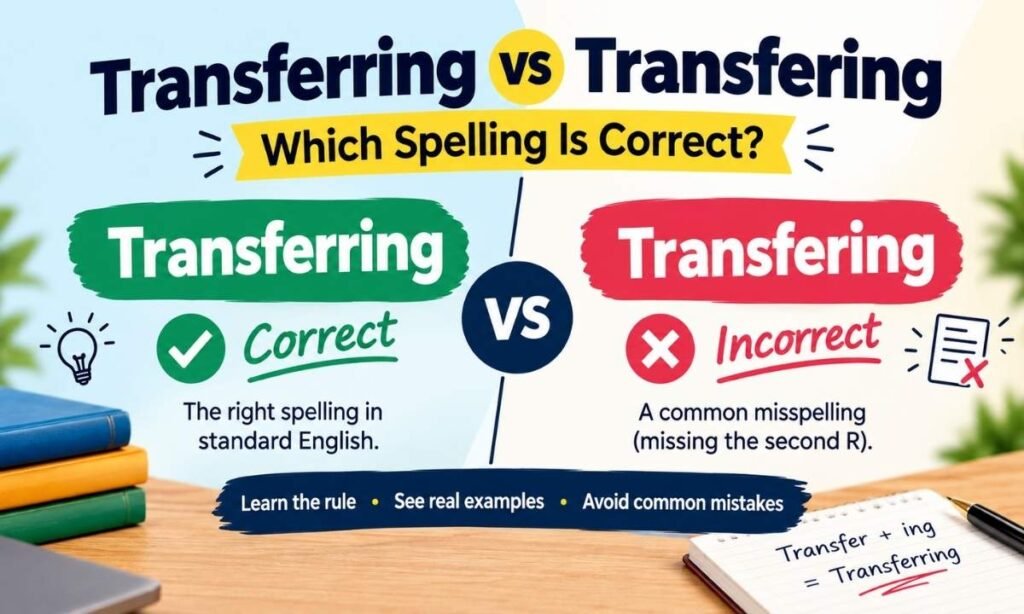
The short answer is simple. Transferring is the correct spelling, and transfering is a misspelling that should be avoided in any formal or professional writing. If you’re comparing Transferring vs Transfering, this guide breaks down the rule, shows real examples, and answers the most common questions people search for on this exact topic.
Transferring or Transfering: The Quick Answer
Transferring is correct. Transfering is incorrect because it drops the required second r before adding ing.
Why This Confuses So Many Writers?
Transfer ends in a single consonant after a stressed syllable, so writers often assume the base word stays the same when a suffix is added. English grammar rules say otherwise for words with this pattern.
The One Rule That Fixes It Forever
If the final syllable of a word is stressed and ends in one vowel plus one consonant, that consonant usually doubles before ing, ed, or er. Transfer fits this pattern exactly.
Why Does Transferring Have Two R’s?
The word transfer is pronounced with stress on the second syllable, trans FUR. When a word ends in a single vowel followed by a single consonant, and that final syllable carries the stress, standard English spelling doubles the consonant before adding a vowel suffix like ing. This keeps the pronunciation consistent, since a single r would visually suggest a long vowel sound, similar to how hoping and hopping mean two completely different things.
Dictionaries and grammar authorities consistently list transfer, transferred, and transferring together as examples of this doubling rule. The same logic applies to refer, prefer, and occur, which is why writers often mix up several similar words at once rather than just this one.
What Does Transferring Mean?

Transferring is the present participle and gerund form of the verb transfer. It describes the act of moving something, or someone, from one place, person, system, or state to another.
In everyday use, transferring can apply to physical objects, digital data, money, responsibility, or even people changing locations such as schools, jobs, or flights. Because the concept of movement is so broad, the word shows up across banking, education, technology, logistics, and legal writing.
How Do You Spell Transferring Correctly?
Start with the base verb transfer. Add a second r, then attach ing. The finished word is transferring, with two r’s sitting side by side right before the suffix.
A simple memory trick many writers use is picturing the word as three parts: transfer, plus an extra r, plus ing. Saying it out loud in that broken down way while writing tends to prevent the common single r mistake.
Transferring vs Transfering Examples
| Correct Sentence | Incorrect Sentence |
| She is transferring funds to her savings account. | She is transfering funds to her savings account. |
| The hospital began transferring patients at noon. | The hospital began transfering patients at noon. |
| He is transferring schools next semester. | He is transfering schools next semester. |
| The company is transferring ownership of the property. | The company is transfering ownership of the property. |
| I am transferring the call to another department. | I am transfering the call to another department. |
When Do You Use the Word Transferring
Transferring Money
Banks and financial apps use this term when funds move between accounts, individuals, or institutions, whether instantly or over several business days.
Transferring Files and Data
In technology, transferring refers to moving documents, photos, or information between devices, drives, or cloud storage systems.
Transferring to Another School
Students and parents use this phrase when enrollment moves from one educational institution to another mid program or between academic years.
Transferring Ownership or Responsibility
Legal and business documents rely on this word when property, assets, or duties formally pass from one party to another.
Transferring a Call
In customer service and office settings, this describes redirecting a phone call from one line, department, or agent to another.
Is Transfering Ever Correct
Transfering is never correct in standard English. It does not appear as an accepted variant in any major dictionary, style guide, or grammar reference. People usually write it this way simply because they forget the doubling rule or type quickly without noticing the missing letter.
If you see transfering in a draft, the fix is always the same: add the second r before ing. There is no context, formal or informal, American or British, where the single r version is treated as acceptable spelling.
The Double Consonant Rule Explained Simply
English doubles a final consonant before adding ing, ed, or er when three conditions are met: the word ends in one vowel followed by one consonant, the final syllable is stressed, and the suffix begins with a vowel. Transfer checks every box, which is why transferring, transferred, and transferee all carry the doubled r.
| Base Word | Doubled Form | Rule Applied |
| Transfer | Transferring | Stressed final syllable, doubles before ing |
| Refer | Referring | Same stress and vowel consonant pattern |
| Prefer | Preferring | Same stress and vowel consonant pattern |
| Occur | Occurring | Same stress and vowel consonant pattern |
| Admit | Admitting | Same stress and vowel consonant pattern |
| Travel (British) | Travelling | Doubled in British English, single l in American English |
Transfer vs Transferred vs Transferring
Transfer is the base verb, used for present tense actions such as I transfer files weekly. Transferred is the past tense and past participle, used for completed actions such as She transferred the deed last year. Transferring is the ongoing or gerund form, used for actions in progress or as a noun, such as Transferring data takes time or He is transferring departments.
Transferring in American and British English
The spelling of transferring does not change between American and British English. Both dialects double the r because the doubling rule depends on stress and syllable structure, not regional spelling preferences. This differs from words like traveling and travelling, where American English keeps a single consonant and British English doubles it. Transfer avoids that split entirely, making transferring one of the more consistent words in global English spelling.
Common Spelling Mistakes With Transferring
● Writing transfering with only one r
● Forgetting the doubled consonant entirely when typing quickly
● Confusing transferring with transferred in sentences that need past tense
● Adding an apostrophe where none belongs
● Mixing up transferring with similar looking words like interfering
Transferring Spelling Compared With Similar Words
Refer becomes referring, prefer becomes preferring, and occur becomes occurring, all following the identical consonant doubling pattern as transfer. Recognizing this shared rule helps writers avoid a whole cluster of spelling errors at once rather than memorizing each word separately.
Quick Transferring vs Transfering Comparison
| Form | Correct | Explanation |
| Transferring | Yes | Correct present participle and gerund form |
| Transfering | No | Missing the required second r |
| Transfer | Yes | Correct base verb |
| Transferred | Yes | Correct past tense form |
| Transferrable | Yes | Correct adjective form, also spelled transferable |
How to Remember the Correct Spelling of Transferring
Think Transfer Plus Double R Plus ING
Breaking the word into three visual chunks makes the extra r easier to remember while typing.
Remember the RR Pattern
Picture the two r’s standing together like a pair, since the stressed syllable always pulls a doubled consonant with it.
Check the Word Before You Submit
A quick proofread pass, or a spellchecker, will catch a missing r before it reaches a resume, report, or email.
Grammar Background That Supports This Spelling
Consonant doubling is one of the oldest and most stable rules in English orthography, tracing back to how vowel length was historically marked in writing. A single consonant after a vowel often signals a long vowel sound, while a doubled consonant signals a short one. This is why later and latter read so differently, and it is the same mechanism protecting the correct pronunciation of transferring.
Industries Where Getting This Word Right Matters Most
Banking, healthcare, education, logistics, and customer service documents all use transferring constantly. A misspelling in a formal letter, contract, or academic paper can undercut credibility, especially in industries where precise language reflects attention to detail.
Editors and hiring managers frequently flag this exact error because it is one of the more common doubling mistakes in professional writing.
Frequently Asked Questions
Is it transferring or transfering?
Transferring is correct. Transfering is a common misspelling that drops the required second r.
Why does transferring have two r’s?
Because the stressed final syllable of transfer doubles its consonant before an ing ending, following standard English spelling rules.
Is transfering a correct word?
No, transfering does not appear in any recognized dictionary and is always considered a spelling error.
How do you spell transferring?
Take the base word transfer, add an extra r, then attach ing, forming transferring.
What is the meaning of transferring?
Transferring means the act of moving something, such as money, data, or responsibility, from one place or person to another.
Is transferring correct in American English?
Yes, transferring is spelled the same way in both American and British English, with no regional variation.
What is the difference between transfer and transferring?
Transfer is the base verb form, while transferring is the ongoing or gerund form used for actions in progress.
What is the past tense of transfer?
The past tense is transferred, formed by doubling the r before adding ed.
Conclusion
Transferring is the correct spelling, and transfering is a misspelling that leaves out the required second r.
The rule is simple: transfer, plus an extra r, plus ing, equals transferring, and the same doubling pattern applies to similar words like referring, preferring, and occurring.