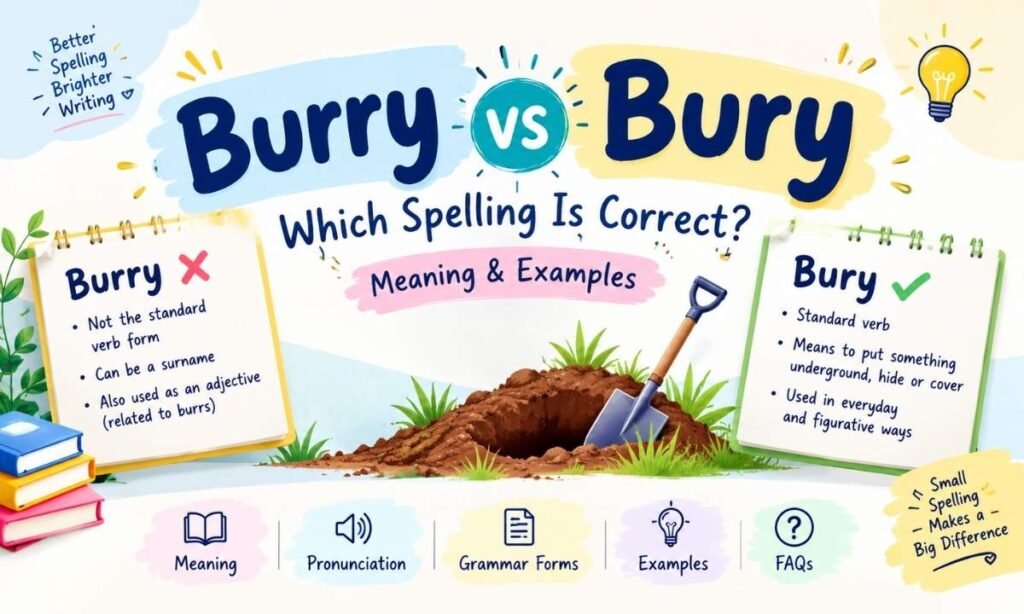
Bury is the standard English verb used when something is placed underground, hidden, or covered. Burry vs Bury is a common spelling confusion. Burry is not the accepted spelling of that verb, though it does show up as a surname and in a narrow adjective sense tied to burrs.
Many English learners and even native speakers mix up these two words because bury does not sound the way it looks. This guide breaks down the meaning, pronunciation, grammar forms, and common mistakes so you never second guess the spelling again.
Understanding the Word Bury
Bury is a verb that carries a few related meanings depending on context.
- To place something in the ground, such as burying a seed or a time capsule
- To hide or cover something from view, such as burying a letter under papers
- To use the word figuratively, such as burying your feelings or being buried in work
Examples:
They decided to bury the time capsule in the backyard. She buried the letter beneath a stack of old books. He tried to bury his emotions instead of talking about them.
Understanding the Word Burry
Burry is rarely the word people actually mean to write. It has two legitimate but uncommon uses.
As an adjective, burry describes something covered in or full of burrs, the small prickly seed pods that stick to clothing and animal fur. A hiker might say their socks felt burry after walking through tall grass.
As a proper noun, Burry appears as a surname and even as a place name in parts of the United Kingdom, such as Burry Port in Wales. In these cases it is spelled correctly and should not be treated as a typo.
Quick Comparison Table (Burry vs Bury)
| Word | Part of Speech | Common Meaning | Standard Verb |
| Bury | Verb | To place underground, hide, or cover | Yes |
| Burry | Adjective or proper noun | Covered in burrs, or a surname | No |
Why Bury Is Often Misspelled as Burry?
English spelling does not always match pronunciation, and bury is a textbook example. The letters suggest a word that should rhyme with fury, yet the actual sound is closer to berry. This mismatch leads many writers to spell the word the way it sounds rather than the way it is traditionally written, producing the incorrect form burry.
How to Pronounce Bury Correctly?
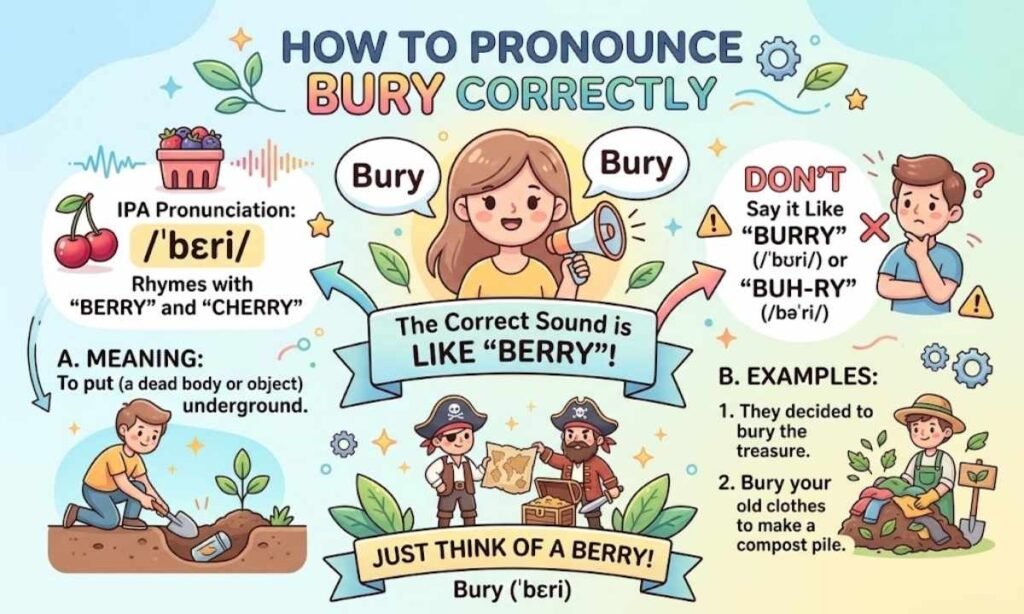
In American English, bury is pronounced beh ree, phonetically written as /ˈbɛri/. This is nearly identical to how the fruit berry is pronounced, which is exactly why the confusion happens so often.
British English generally follows the same pronunciation pattern, though some regional accents may shift the vowel sound slightly. Regardless of accent, the spelling remains bury in both American and British English.
Bury in Everyday Sentences
Everyday examples:
The dog likes to bury its favorite bone in the yard. We will bury the time capsule tomorrow afternoon. They buried the old photographs in a wooden box.
Formal examples:
The archaeologists carefully buried the ancient remains according to tradition. The family chose to bury him near his childhood home.
Figurative examples:
The important email got buried under hundreds of unread messages. She buried herself in work to avoid thinking about the news.
Grammar Forms: Bury, Buried, Burying
Understanding how bury changes across tenses helps avoid a second common mistake.
- Bury is the base form, used for present and future actions, as in I will bury the letter.
- Buried is both the past tense and past participle, as in she buried the box yesterday.
- Burying is the present participle, as in they are burying the seeds today.
Notice that the final y changes to i before adding ed, which is a standard spelling rule for many English verbs ending in a consonant plus y.
Is Burried a Correct Spelling?
Burried, with two r letters, is never correct. The proper past tense form has only one r, spelled buried. A simple way to remember this is the rule bury plus ed becomes buried, not burried.
Incorrect: They burried the treasure last summer. Correct: They buried the treasure last summer.
The History and Origin of the Word Bury
The word bury traces back to Old English byrgan, meaning to hide or protect, which itself connects to a broader Germanic root related to shelter and protection. Over centuries the spelling stayed close to its Old English roots even as pronunciation shifted, which explains the unusual gap between how the word looks and how it sounds today. This same root also appears in place names across England, such as Canterbury and Shrewsbury, where the ending bury historically referred to a fortified settlement or town.
Bury in Idioms and Everyday Expressions
English uses bury in several fixed expressions that go beyond the literal meaning.
- Bury the hatchet means to make peace after a disagreement
- Bury your head in the sand means to ignore an obvious problem
- Bury the lede means to hide the most important part of a story
- Dead and buried describes something that is permanently finished
Learning these expressions helps writers use bury naturally in conversation and content rather than only in literal contexts.
Bury vs Similar Sounding Words
Because bury sounds like berry, it also gets confused with a small group of related terms.
| Word | Meaning | Example |
| Bury | To place underground or hide | Bury the seeds in soil |
| Berry | A small round fruit | She picked a berry from the bush |
| Barry | A common first name | Barry works at the office |
Keeping these three separated in your mind, especially by meaning rather than sound, prevents mixing them up in writing.
Regional Differences: American vs British Usage
Both American and British English spell the word the same way, bury, buried, and burying. The difference is mostly limited to accent, where some British dialects may pronounce the vowel with a slightly different quality than the flat American beh sound. Neither region uses burry as an accepted alternative spelling of the verb.
Tips for Writers and Content Creators
Writers who frequently publish articles, scripts, or reports can avoid this mistake by building a quick mental check before hitting publish.
- Read the sentence aloud and confirm it means to place underground or hide
- If so, the correct spelling is always bury, buried, or burying
- Reserve burry only for describing something covered in burrs or referring to a surname
- Run a final spell check pass focused specifically on commonly confused homophones
Common Spelling Mistakes to Avoid
- Burry instead of Bury
- Burried instead of Buried
- Burrying instead of Burying
Keeping a short list like this on hand is especially useful for students, bloggers, and non native English speakers who are still building confidence with tricky spellings.
Frequently Asked Questions
Is burry a real word?
Burry can appear as an adjective meaning covered in burrs or as a surname, but it is not the correct spelling of the verb meaning to place underground.
Is bury or burry correct?
Bury is correct for the verb meaning to place something underground or hide it; burry is not a standard alternative.
How do you spell bury?
The correct spelling is b u r y, with only one r and no double letters.
How do you pronounce bury?
Bury is pronounced beh ree, almost exactly like the fruit berry, in both American and British English.
What is the past tense of bury?
The past tense and past participle of bury is buried, formed by changing the y to i and adding ed.
Is burried a correct spelling?
No, burried with two r letters is always incorrect; the proper spelling is buried with a single r.
Is bury spelled the same in American and British English?
Yes, bury, buried, and burying are spelled identically in both American and British English, with only minor pronunciation differences.
Conclusion
Bury is the word to use whenever you mean placing something underground, hiding it, or covering it, whether literally or figuratively. Burry should be avoided as a substitute for that verb, since its only legitimate uses are as an adjective describing something full of burrs or as a proper name.
Once you connect the spelling to its meaning and remember the simple rule for forming buried, this common mix up becomes easy to avoid for good.