Flies is the standard spelling in modern English. Flys is not the normal spelling for either the plural noun or the third-person singular verb form of fly.
Fly does two jobs. As a noun, it names an insect (one fly, two flies). As a verb, it means to move through the air, or to travel by air (she flies to New York). Both uses take the same spelling: flies.
Flys vs Flies: The Quick Answer
When to Use “Flies”
Use flies whenever you mean:
• More than one insect: There are flies in the kitchen.
• He, she, or it + fly: He flies. She flies. It flies.
• The saying Time flies.
• The phrase flies by: The summer flies by.
When “Flys” Is Not Correct
In ordinary modern English, the plural of the noun and the third-person singular of the verb are both spelled flies, never flys.
Flys does turn up in rare places: some historical sources record it for specialized older senses, and a name or brand can deliberately include it. None of that makes it the normal spelling of the word fly. That qualification is more accurate than claiming flys never appears anywhere, and it does not change what you should write.
What Does “Flies” Mean?
“Flies” as a Plural Noun
• one fly, two flies
• one housefly, several houseflies
• a fly, many flies
“Flies” as a Verb
• The bird flies.
• She flies to New York.
• The plane flies every morning.
• Time flies.
Major dictionaries, including Collins and Cambridge, list flies for both the noun and the verb.
Why Is “Flies” Correct Instead of “Flys”?
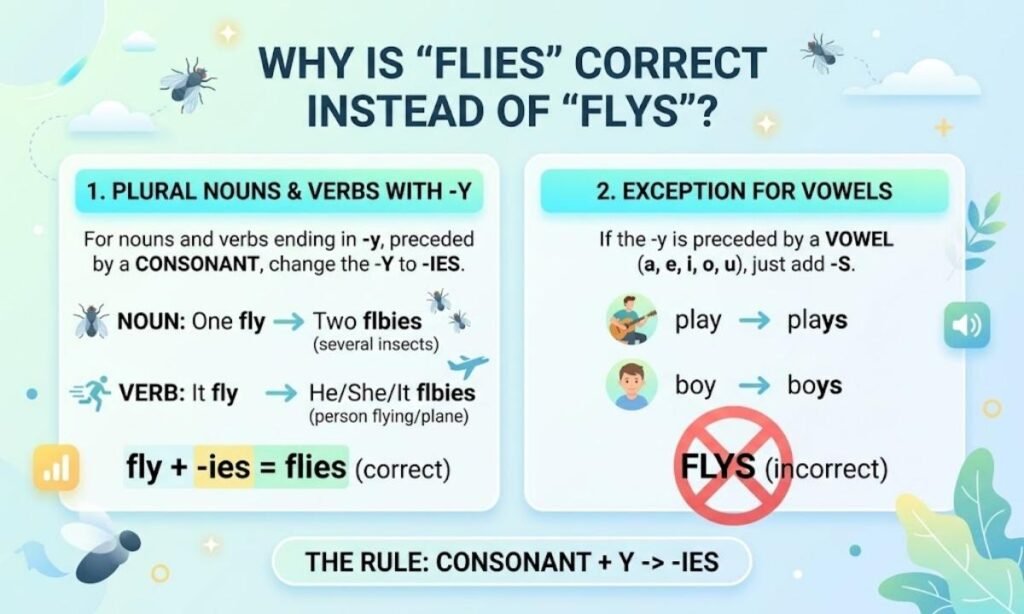
The Consonant + Y Spelling Rule
When a word ends in a consonant + y, change the y to i and add -es:
• fly, flies
• try, tries
• cry, cries
• study, studies
• carry, carries
Fly ends in l + y, a consonant followed by y, so the rule applies.
Why “Flys” Looks Like It Should Be Correct?
Most English words form plurals and third-person verbs by simply adding -s (cat, cats; run, runs). It is natural to assume fly works the same way. It does not, because of the consonant + y rule above.
Fly vs Flies: What Changes in a Sentence?
| Form | Grammar | Example |
| fly | base verb | I fly often. |
| flies | third-person singular | She flies often. |
| flew | past tense | She flew yesterday. |
| flown | past participle | She has flown before. |
| flying | present participle | She is flying now. |
What Is the Plural of “Fly”?
One Fly vs Two Flies
• One fly
• Two flies
• Several flies
• Many flies
Why “Flys” Is Not the Standard Plural
The plural of fly is flies. Cambridge and Collins both list it that way. If you searched “fly plural,” that is the answer.
Is It “He Flys” or “He Flies”?
Correct: He Flies
• He flies to Chicago.
• He flies planes for a living.
• He flies home every Friday.
What About I, You, We, and They?
Only the third-person singular takes flies. Every other person uses the base form:
• I fly
• You fly
• We fly
• They fly
• He flies
• She flies
• It flies
Is It “Time Flys” or “Time Flies”?
Correct: “Time flies.”
What Does “Time Flies” Mean?
It means time seems to pass quickly, especially when you are busy or enjoying yourself.
“Time Flies By” vs “Time Flys By”
Correct: “Time flies by.” The same logic applies to anything that passes quickly: the weekend flies by, the year flies by.
Don’t Confuse “Flys,” “Flies,” and “Fly’s”
| Form | Meaning | Example |
| fly | singular noun / base verb | A fly landed here. |
| flies | plural noun / verb | Two flies are outside. |
| fly’s | possessive / contraction | The fly’s wings are small. |
| flys | nonstandard in ordinary modern usage | Incorrect: He flys every week. |
“Fly’s” as a Possessive
The fly’s wings are transparent. (The wings belong to the fly.)
“Fly’s” as a Contraction
The fly’s in the kitchen. Here, fly’s means fly is.
Common Sentences: Flys or Flies?
| Incorrect | Correct |
| The bird flys away. | The bird flies away. |
| There are three flys. | There are three flies. |
| Time flys quickly. | Time flies quickly. |
| She flys to Boston. | She flies to Boston. |
| The plane flys at night. | The plane flies at night. |
| Two flys landed on the table. | Two flies landed on the table. |
More Examples of “Flies” in Everyday English
Examples as a Noun
• Flies buzzed around the picnic table.
• We put a screen on the window to keep the flies out.
• The frog snapped up two flies in a single second.
• Fruit flies gathered around the bowl of bananas.
• Houseflies tend to show up when the weather warms.
• The barn was full of flies by midsummer.
• Fishermen tie their own flies to use as lures.
Examples as a Verb
• The eagle flies high above the canyon.
• This airline flies to Denver twice a day.
• My sister flies home every Thanksgiving.
• The flag flies at half-staff today.
• A kite flies best on a breezy afternoon.
• Time flies when you’re having fun.
• The ball flies over the fence on every swing.
Examples With “Flies By”
• The weekend flies by.
• Every year flies by faster than the last.
• Summer flies by once school lets out.
• Our vacation always flies by.
• Time flies by when the kids are young.
Why Do People Write “Flys” Instead of “Flies”?
The “Just Add S” Mistake
Most nouns and verbs just add -s, so writers apply the default pattern to fly without thinking about the exception.
Confusion With Words Like “Toys” and “Boys”
Words ending in a vowel + y keep the y and add -s:
• toy, toys
• boy, boys
• day, days
Words ending in a consonant + y change to -ies:
• fly, flies
• baby, babies
• city, cities
The Easy Rule to Remember
Consonant + Y becomes IES.
Flys vs Flies in American and British English
Is “Flies” the Same in US and UK English?
Yes. Both varieties use flies.
Is “Flys” a Regional Spelling?
No. Flys is not a regional variant for the ordinary noun or verb. Cambridge and Collins both support flies as the standard form.
Can “Flys” Ever Be Correct?
Rare Historical Uses of “Flys”
Older texts sometimes contain flys for particular historical senses. These are specialized exceptions, not guidance for modern writing.
Proper Names and Brands
A person, business, or product can intentionally be named with Flys. That does not make it the standard spelling of the word fly.
What Should You Use in Normal Writing?
Use flies.
Flies vs Flys: A Simple Rule to Remember
Fly + standard plural/third-person form = flies.
• fly, flies
• try, tries
• cry, cries
• study, studies
Frequently Asked Questions
Is “flys” a correct spelling?
No, not in ordinary modern English. The standard spelling for both the plural noun and the verb form is flies.
Is it “flys” or “flies”?
It is flies. This applies to more than one insect and to the verb with he, she, or it.
What is the plural of “fly”?
The plural of fly is flies, as in one fly and two flies. The y becomes i because it follows a consonant.
Is it “he flys” or “he flies”?
It is he flies, as in He flies to Chicago every week. The third-person singular always takes flies.
Is it “she flys” or “she flies”?
It is she flies, as in She flies to Boston on Mondays. The same rule applies to he and it.
Is “time flys” or “time flies” correct?
The correct form is time flies. It is a common saying that means time seems to pass quickly.
Is “flys by” or “flies by” correct?
The correct form is flies by, as in The summer flies by. Flys by is a spelling mistake.
What is the difference between “flies” and “fly’s”?
Flies is a plural noun or a verb form. Fly’s is either a possessive (the fly’s wings) or a contraction of fly is (the fly’s in the kitchen).
Conclusion
Flies. It is the correct spelling for both the plural noun and the verb with he, she, or it.
Flys is a common spelling mistake. Because fly ends in a consonant + y, it becomes flies, just like try, tries and cry, cries. Use flies in everyday writing and you will be correct.