If you have ever paused mid-sentence wondering whether to write “laid out” or “layed out,” you are not alone. This mix up is one of the most common spelling mistakes in English, and it trips up even confident writers because the verb “lay” behaves differently from most regular verbs.
The short answer is that “laid out” is correct, and “layed out” is not a standard word in English. This guide breaks down why that is true, what “laid out” actually means, and how to use it correctly in real sentences.
Laid Out or Layed Out: Which Is Correct
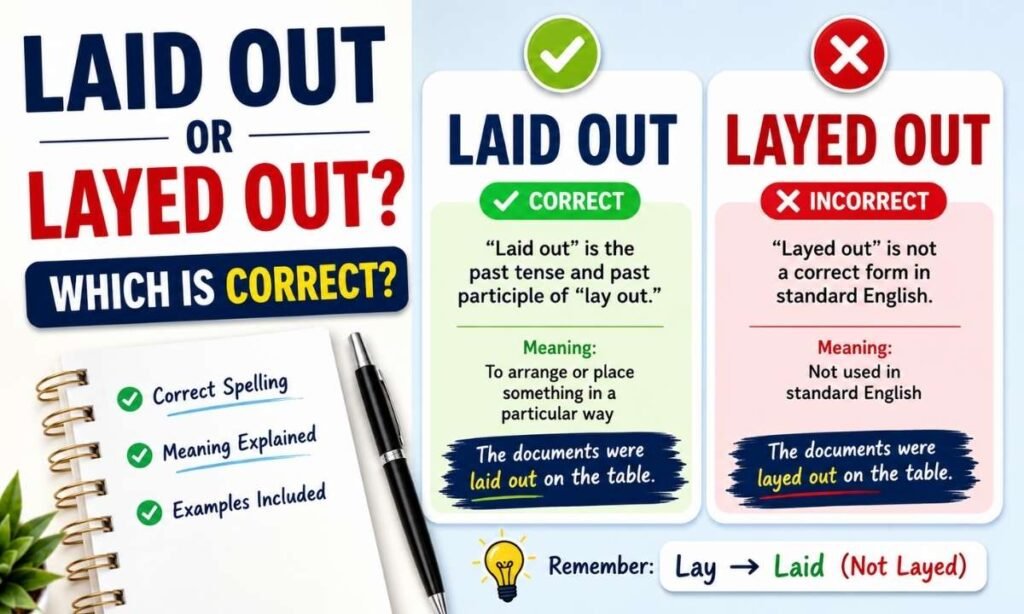
“Laid out” is the correct spelling. “Layed out” is a common misspelling that does not appear in standard dictionaries. “Laid” is the past tense and past participle of the verb “lay,” and English simply does not add “ed” to form it.
Quick Answer
Always use “laid out” when writing in the past tense. “Layed out” is never correct in formal or standard English.
Why Do People Write Layed Out?
Most regular English verbs form their past tense by adding “ed,” such as walk becoming walked or play becoming played. Because “lay” sounds like it should follow that same rule, many writers naturally guess “layed” instead of learning the irregular form.
What Does Laid Out Mean?
“Laid out” carries several related meanings depending on the sentence, which is part of why it shows up so often in everyday writing.
- Arranged or organized in a clear way
- Explained or presented so ideas are easy to follow
- Spread across a surface or a space
- Designed, as in a page, room, or building layout
- Spent money, as in an older or more formal sense of the phrase
Because the phrase covers arranging, explaining, and designing all at once, it fits naturally into instructions, business writing, and everyday conversation alike.
Why Is Layed Out Incorrect?
English verbs fall into two broad groups: regular verbs that take “ed,” and irregular verbs that change form entirely. “Lay” belongs to the irregular group, so its past tense simply does not follow the standard pattern.
The correct pattern looks like this: lay becomes laid in the past tense, and it stays laid in the past participle as well. There is no version of this verb that adds “ed” onto the base word, which is exactly why “layed” never appears in dictionaries or grammar guides.
Lay Out vs Laid Out: What Is the Difference
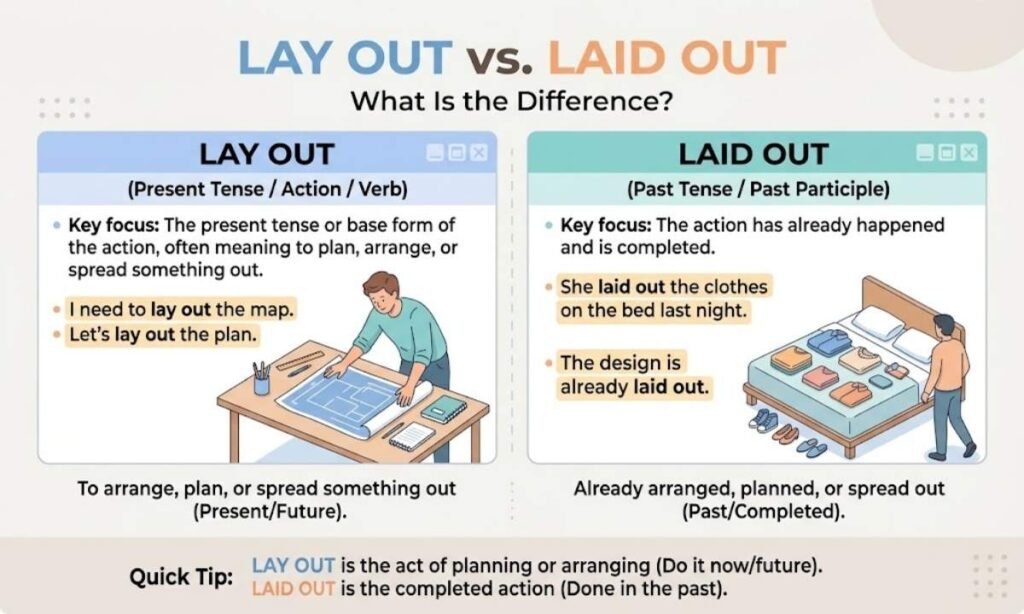
“Lay out” is the present or base form of the verb, used when describing an action happening now or in general. “Laid out” is the past form, used when the action already happened.
For example, “I lay out my clothes every night” describes a habit in the present, while “I laid out my clothes last night” describes something already completed. The same word also serves as the past participle, which is why you will see it paired with “has” or “had,” as in “she has laid out the schedule for next week.”
Laid Out vs Layout: Don’t Mix Them Up
These two terms look similar but serve completely different grammatical roles. “Lay out” and “laid out” are verbs describing an action, while “layout” is a noun describing the finished result.
A simple way to separate them: you lay out a page, and once it is finished, that page has a layout. Writing “the new layed out” or “the new lay out” instead of “the new layout” is a common error worth double checking before publishing anything professional.
Lay vs Lie vs Laid: Why They Get Confused
Part of the confusion around “laid out” comes from a bigger mix up between “lay” and “lie,” two verbs that overlap in meaning but work differently in a sentence.
“Lay” means to put something down and always takes an object, as in “lay the book on the table.” “Lie” means to recline or rest and never takes an object, as in “I want to lie down.” Their past tense forms make the confusion worse, since the past tense of “lie” happens to be “lay,” while the past tense of “lay” is “laid.”
The Origin of the Confusion Between Lay and Lie
This overlap is not accidental. Historically, “lay” and “lie” come from closely related Old English verbs that already shared similar sounds and meanings, which is part of why modern English never fully separated them in casual speech. Add to that the fact that “lay” is also the past tense of “lie,” and it becomes easy to see why even native speakers mix these verbs up constantly, especially in spoken conversation where grammar rules get relaxed.
How to Use Laid Out in a Sentence?
“Laid out” fits naturally into many everyday and professional situations, which is why it appears so often in writing.
- Plans and instructions: “The manager laid out the new process for the team.”
- Objects and materials: “She laid out the tools before starting the repair.”
- Information and ideas: “He laid out his argument clearly and calmly.”
- Designs and pages: “The designer laid out the magazine spread overnight.”
- Everyday conversation: “We laid out our weekend plans over dinner.”
Laid Out Examples You Can Use
Seeing correct and incorrect versions side by side makes the rule easier to remember.
| Correct | Incorrect |
| The teacher laid out the instructions clearly. | The teacher layed out the instructions clearly. |
| She laid out the documents on the desk. | She layed out the documents on the desk. |
| He laid out his plan for the project. | He layed out his plan for the project. |
| The designer laid out the page neatly. | The designer layed out the page neatly. |
Laid Out in Professional and Business Writing
Business communication relies heavily on this phrase, since it fits perfectly into reports, presentations, and planning documents. Phrases like “the proposal laid out three key goals” or “the report laid out our quarterly targets” appear constantly in formal writing, which makes getting the spelling right especially important for anyone sending emails, reports, or client facing documents.
A single misspelling like “layed out” in a resume or business proposal can quietly undercut an otherwise polished piece of writing.
How Autocorrect and Spellcheck Handle Layed Out?
Most modern spellcheckers and autocorrect tools will flag “layed” as incorrect, often suggesting “laid” automatically.
However, some messaging apps and casual writing tools are more lenient, and predictive text can sometimes accept the wrong form if a user has typed it repeatedly. Relying on autocorrect alone is not a safe habit, since context sensitive tools occasionally miss irregular verb errors that a strict grammar checker would catch.
Common Mistakes With Laid Out
A few related errors tend to show up alongside this one.
- Writing “layed out” instead of “laid out”
- Using “lay out” in a sentence that is clearly in the past tense
- Confusing “lay” with “lie” in everyday speech
- Mixing up “laid out” with the noun “layout”
- Using “laid” without an object when “lie” was actually intended
Easy Trick to Remember Laid Out vs Layed Out
A simple memory trick makes this rule stick. Remember the pattern lay becomes laid, never layed. If you can mentally swap in “placed” and the sentence still makes sense, “laid” is almost always the correct choice.
Regional and Dialect Variations in Everyday Speech
While standard written English is consistent on this rule, casual spoken dialects in various English speaking regions sometimes blur lay and lie in relaxed conversation, similar to other irregular verb pairs. This kind of informal drift is common in spoken language worldwide, but it does not change the accepted rule in written English, where “laid out” remains the only standard form across American, British, and other major English varieties.
Practice Exercise: Test Yourself on Laid Out
Try filling in the blank with either “laid out” or “lay out” before checking the answer below each line.
- Yesterday, she ______ the entire itinerary for the trip. (laid out)
- Every morning, he ______ his notes before the meeting. (lays out)
- The architect has already ______ the floor plan. (laid out)
Laid Out vs Layed Out: Quick Comparison
| Phrase | Correct | Typical Use |
| laid out | Yes | Past form of lay out |
| layed out | No | Nonstandard spelling |
| lay out | Yes | Present or base form of the verb |
| layout | Yes | Noun describing the arrangement |
Frequently Asked Questions
Is it laid out or layed out?
“Laid out” is correct. “Layed out” is not a recognized word in standard English.
Why is laid out correct?
Because “laid” is the accepted irregular past tense and past participle of the verb “lay.”
Is layed out grammatically correct?
No, it is a common misspelling and does not appear in standard dictionaries.
What is the past tense of lay out?
The past tense is “laid out,” used for actions that already happened.
What is the difference between lay out and laid out?
“Lay out” is present tense, while “laid out” describes something already completed.
Is layout one word?
Yes, “layout” is a single noun describing an arrangement or design, separate from the verb form.
What is the difference between laid and lain?
“Laid” is the past form of “lay,” while “lain” is the past participle of “lie,” used without an object.
Conclusion
“Laid out” is the only correct choice whenever you are describing something arranged, explained, or spread out in the past. Once you remember that “lay” becomes “laid” and never “layed,” this common grammar mistake becomes easy to avoid in emails, reports, and everyday writing.