
If you have ever paused mid sentence wondering whether to write Leafs or Leaves, you are not alone. English speakers mix these two words up constantly, and search engines see millions of queries every month asking for the correct plural form of leaf.
This guide gives you the direct answer first, then walks through the spelling rule behind it, real example sentences, common mistakes, and a full breakdown of related irregular plural nouns so you never second guess yourself again.
What Is the Plural of Leaf?
The plural of leaf is leaves. This follows a spelling pattern used by many English nouns that end in f or fe, where the f changes to v before adding es. So one leaf becomes two leaves, and the word leafs is not the standard plural form in modern English grammar.
Leaf to Leaves: The Quick Answer
Leaf is singular. Leaves is plural. The change happens because Old English nouns ending in f softened to a v sound when followed by a vowel, and that pronunciation shift eventually became fixed in spelling.
Is Leafs the Plural of Leaf?
No, leafs is not a standard plural noun. It only appears as a verb form, such as he leafs through a magazine, or inside a proper name like the Toronto Maple Leafs hockey team.
Singular vs Plural of Leaf at a Glance
| Form | Word | Example |
| Singular | leaf | A leaf fell from the tree. |
| Plural | leaves | The leaves covered the yard. |
Why Does Leaf Change to Leaves?
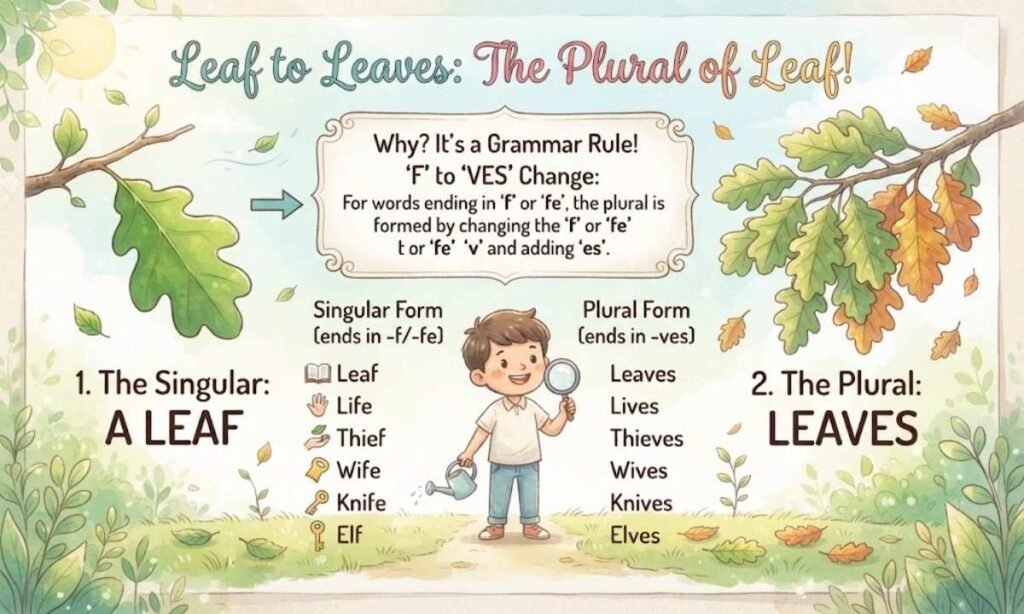
English inherited a group of nouns from Old English where a final f sound naturally voiced into a v sound once a suffix was attached. Over centuries that pronunciation habit got locked into spelling, which is why leaf, knife, and wife all follow the same transformation.
The F to Ves Plural Rule
Many nouns ending in f or fe drop that ending and add ves to form the plural. Leaf becomes leaves, knife becomes knives, and life becomes lives, all using the same underlying pattern.
Why English Has Irregular Plural Nouns
English absorbed vocabulary and grammar habits from Old English, Norse, and French over hundreds of years, and each layer left behind its own pluralization quirks. That blending is exactly why English has so many irregular plurals instead of one universal rule.
Does Every Word Ending in F Become Ves?
No, and this is the part many articles skip. Plenty of common words ending in f simply add an s, including roof, chief, and belief, so the ves pattern is common but never automatic.
Leafs or Leaves: Which One Is Correct?
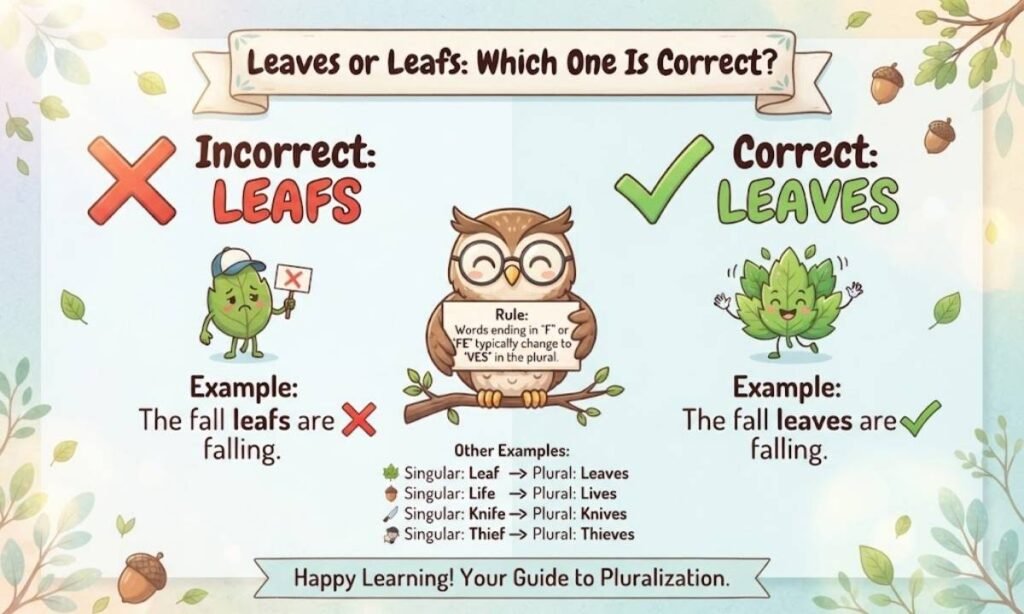
Leaves is correct whenever you are describing more than one leaf from a plant or tree, or referring to sheets of paper in a book. Leafs is correct only as a verb or as part of a fixed proper noun.
When to Use Leaves
Use leaves any time you are talking about multiple plant leaves, pages in a document, or hinged sections of a table, since all of these senses take the same irregular plural form.
When Leafs Is Correct
Leafs is correct when a person leafs through something, meaning to flip pages quickly, or when referring to the Toronto Maple Leafs by their official team name.
A Simple Trick to Remember the Difference
Picture a tree in autumn. Trees drop leaves, never leafs. If your sentence involves a tree, garden, plant, or paper, leaves is almost always the word you want.
When Is Leafs a Correct Word?
Leafs shows up in English for two specific reasons, and understanding both keeps you from misusing either form in formal writing.
Leafs as a Verb
As a verb, leafs describes the action of turning pages, as in she leafs through the catalog before making a decision. Here it functions like walks or talks, taking an s for the third person singular.
Leafs in the Toronto Maple Leafs Name
The Toronto Maple Leafs deliberately kept the singular style leafs instead of leaves when the hockey team was named, and that spelling has remained fixed as a brand identity ever since.
How to Use Leaves in a Sentence?
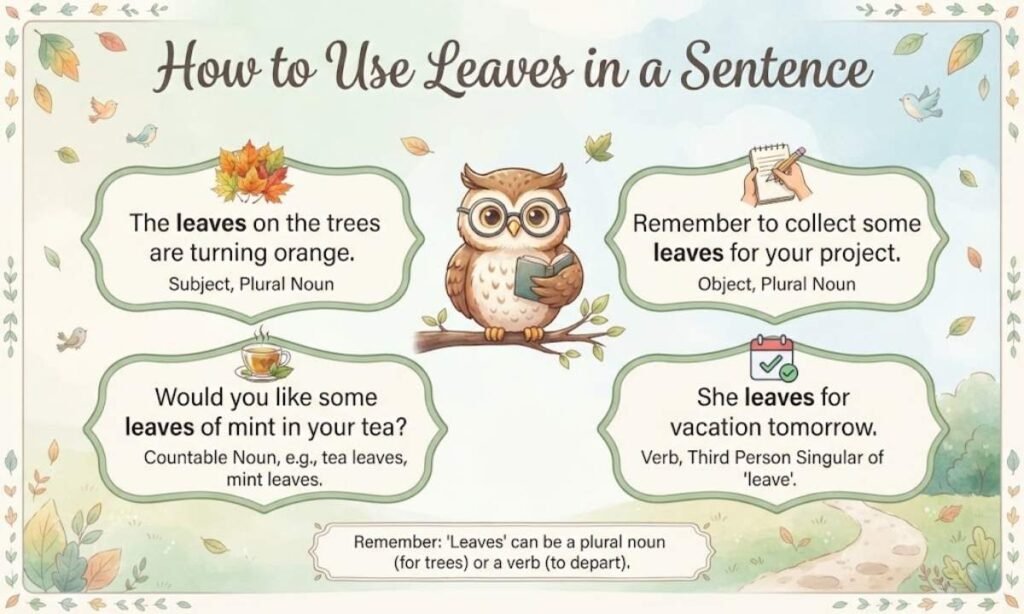
Seeing leaves used across different contexts makes the correct plural form easier to remember and apply naturally in your own writing.
Examples in Nature and Gardening
The maple leaves turned bright orange in October. Water the plant if its leaves start to droop. Gardeners rake fallen leaves every weekend during autumn.
Examples in Everyday and Scientific Writing
The recipe calls for fresh basil leaves. Botanists studied how leaves absorb sunlight through photosynthesis. The tea is made from dried herbal leaves.
Other Meanings of Leaves
Leaves is not limited to plants, which is part of why the word causes confusion in different reading contexts.
Leaves as Pages in a Book
In older or formal writing, leaves can refer to the individual sheets of paper bound into a book, where each leaf has a front and back page.
Leaves as a Verb Form of Leave
Leaves can also be the present tense verb form of leave, as in the train leaves at noon, which is grammatically unrelated to the plural noun spelled the same way.
Plural Nouns Similar to Leaf
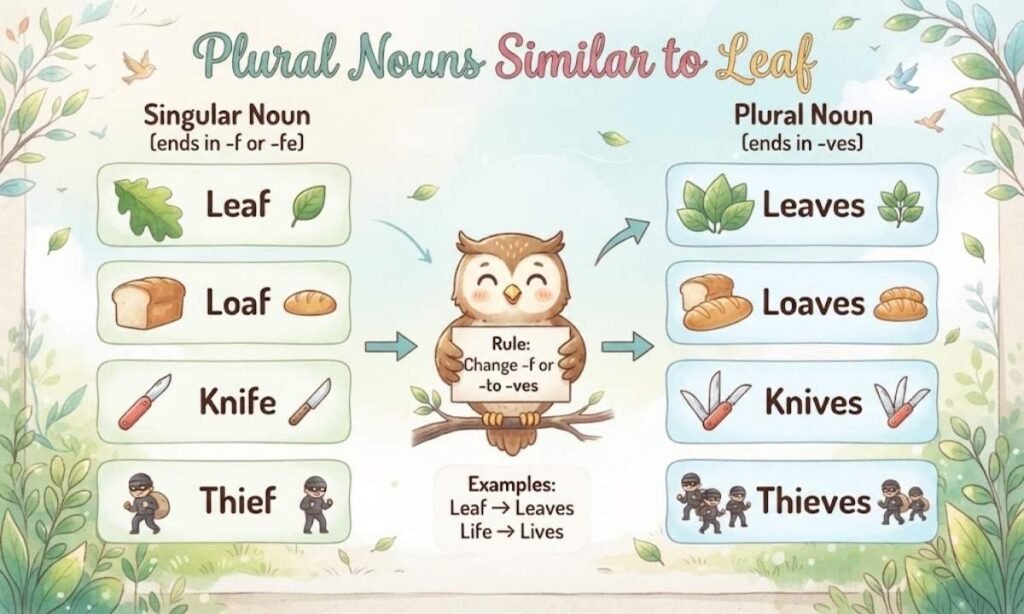
Several everyday English nouns follow the exact same f to ves transformation as leaf, and learning them together reinforces the pattern.
- Knife becomes knives
- Wolf becomes wolves
- Shelf becomes shelves
- Wife becomes wives
- Half becomes halves
Words Ending in F That Just Add S
Not every f ending noun follows the ves rule, and mixing these up is one of the most common grammar mistakes in English writing.
| Word | Correct Plural | Rule Type |
| roof | roofs | adds s only |
| chief | chiefs | adds s only |
| belief | beliefs | adds s only |
| proof | proofs | adds s only |
| leaf | leaves | changes to ves |
There is no shortcut formula that predicts which f ending words switch to ves, so the safest approach is memorizing common exceptions like roof and belief individually.
Common Mistakes People Make With Leaf’s Plural
Writers frequently confuse leaf’s plural form with related but grammatically different constructions.
- Writing leafs when describing multiple plant leaves instead of leaves
- Confusing leafs the verb with leaves the plural noun in the same sentence
- Adding an apostrophe to write leaf’s when the plural leaves was intended
- Changing the hockey team name to Toronto Maple Leaves, which is factually incorrect
Leaf in British English vs American English
The plural rule for leaf does not change between British and American English, since leaves is standard in both dialects. What does differ occasionally is regional vocabulary around leaves, such as British English favoring autumn and American English favoring fall, though both describe the same season when leaves change color and drop.
Tips for Teaching Kids the Plural of Leaf
Young learners often overgeneralize the regular add an s rule, which leads to mistakes like leafs. Teachers and parents can reinforce leaves through repetition with visual aids, such as pointing to a picture of one leaf next to a pile of leaves, and pairing the word with familiar sibling nouns like knife and knives so the pattern feels consistent rather than random.
Frequently Asked Questions
What is the plural of leaf?
The plural of leaf is leaves, formed by changing the final f to v and adding es.
Is leafs or leaves correct?
Leaves is the correct plural noun. Leafs only works as a verb or inside a proper name.
Is leafs a real word?
Yes, leafs is real, but only as a verb form like he leafs through a book.
Why does leaf become leaves?
It follows an old English sound pattern where f softened to v before a vowel ending.
Can I say two leafs?
No, the grammatically correct phrase is two leaves, not two leafs.
Is leaves always the plural of leaf?
Almost always, except when leaves is instead the verb form of leave, as in the bus leaves soon.
What is the plural of a leaf on a tree?
Leaves is the plural, whether you mean tree foliage, garden plants, or fallen autumn leaves.
Conclusion
One leaf becomes two leaves in standard English grammar. Leafs is reserved for the verb form, as in she leafs through a magazine, or for proper names like the Toronto Maple Leafs. Once you remember this simple split, you will never mix up leaves and leafs again.